Just to set expectations, SpaceX has tried to recover the 1st stage of almost all of its launches to date. (Using just parachutes for most of them). They've yet to successfully recover a first stage.
Their most recent test went pretty well all things considered. For the first time they tried a "death swoop" maneuver, turning the 1st stage 180 degrees around as it was starting to re-enter and refire some of the engines to slow it down. It picked up a nasty roll though and centrifuged the propellant, cutting the engines prematurely. They recovered some debris but that's about it.
It's hard to overstate how big a deal it will be if they pull this off. But the odds of success are very low, given the propensity of these things to tumble and roll on reentry.
It's not that they have been "unsuccessfully trying". They were not expecting to recover the previous launch vehicles. Instead, the past re-entry attempts have been entirely successful in that they have provided exactly what they expected to get out of the tests. Data.
The data from the last launch provided a lot of really crucial information that has informed design decisions made for this and following launches.
It's actually better if the next recovery fails too, at least if it happens in a way that provides really important data. This would then let them work out the engineering and science required to improve the design further.
"This test is not a primary mission objective and has a low probability of success (30-40%), but we hope to gather as much data as possible to support future testing."
This test isn't expected to be successful, either.
I was under the impression that they were specifically not using parachutes, that way they would be refining technology that would be useful on other planets.
Do you know how fast the Falcon 9 1st stage gets? Judging by the video animation of their long term re-usability plan, the 1st state separates before it achieves a velocity necessitating re-entry.
Everything that isn't going into orbit requires "re-entry". The typical friction re-entry is used on capsules because it is cheap (all you need is a heat shield and some RCS engines) a "powered" re-entry can be done at well below thermal stress levels, but hasn't been in the past because the fuel used means you're not putting as much mass into orbit as you could have (the mass fraction).
If you know the first stage mass, relative to the lift off mass, you can compute the energy needed to decelerate it to 0 from what ever velocity it reaches at separation. Because fuel is a significant component of the launch weight, you need significantly less fuel to return the nearly empty stage than you did to put it up there to begin with.
Hey, thanks much. That's useful. For everyone else's information, low-earth orbit is ~8km/s, or Mach 24. According to Wikipedia, "Thermal control becomes a dominant design consideration" above Mach 10.
If anyone knows anything about the how the first stage is shielded, I'd be very interested to know. In the artistic video, you can see a quick peak of the nose of the first stage. It's colored tan/yellow like the heat shield on the second stage, but there aren't many details. (Presumably, this was purposefully vague.)
The orange you are seeing at the top of the bottom stage may be either a tank or some sort of shielding for the tanks from the upper stage. I know the upper stage looks like it will use it's own heat shield... but it will also be re-entering from a much higher orbit.
The engines on a rocket are designed to withstand huge amounts of heat. It may be the intent is to have the rocket re-enter engine first. I'd love to see more information on that part of the rocket myself. Certainly interesting :D
The engines do not burn for the majority of descent. You turn the engines forward and make a short burn. This reduces your velocity and causes the orbit of your ship to eventually enter the atmosphere.
Atmospheric drag is then going to provide most of your deceleration, slowing you down to terminal velocity. You then make another burn at the very end of the flight to slow down from terminal velocity and stop.
The second stage is a good example. After making a deceleration burn, it will be re-orienting so that the heat shield at the top is facing the direction of movement. It will then keep this orientation until it is safe to orient the vehicle around for landing.
You could use your engines for most of the deceleration... but it would consume a very large amount of fuel. No point in doing so when you already have atmospheric drag to do the work for you.
I didn't mean the engines were on the whole way down. But if they aren't pointing in the right direction to begin with, you need to flip the entire 70m-long stage around somewhere in the atmosphere. Even at terminal velocity it's moving pretty fast, and I doubt it will survive going sideways at 100m/s through the air, never mind that you need some thrusters that can even develop enough force to flip it around.
That animation for the second stage reentry is an animation. Recovering the second stage will be extremely difficult and, if it is ever done successfully, I don't think it'll involve doing a 180 flip in the lower atmosphere.
This [1] forum post on nasaspaceflight.com says at stage 1 cutoff, velocity is 2,531 m/s (mach 6.76) and altitude is 84.1 km. The actual deceleration burn starts 12 seconds after that, when the stage has coasted up to nearly 100km and has slowed (slightly) to 2,479 m/s.
I don't think (?) this altitude and speed requires heat shielding for the 1st stage. The 2nd stage is jettisoned far too fast and high to make recovery feasible (for now!).
Assuming "re-entry" means "to decelerate from (near) orbital velocity" and not "to pass from vacuum-to-atmosphere", isn't this a solved problem for fast high-altitude jets (e.g. SR-71 Blackbird, 3,529.6 km/h). Wait, I see the problem:
These kind of things seem to happen often. I know helium is very hard to keep in containment due to it's atom size. Nonetheless, I wonder if there's technologies being developed right now that could fix that once and for all.
This will pretty much never happen barring something unlikely like force-fields. For comparison, when they go to ultra low vacuum in the lab, after all the effort of pumping everything down, lasering off contaminants and what not...you start getting helium just leaking into your chamber.
Because you're using helium-3 as a dilution refrigerant, and you've made it sufficiently low pressure that the stuff just diffuses through your massively thick stainless steel container and into your vacuum vessel - at a low rate, but it does.
>Helium atoms are also smaller than Hydrogen atoms
How is that?
Hydrogen atom is one proton + one electron [1], and "Helium is composed of two electrons bound by the electromagnetic force to a nucleus containing two protons along with either one or two neutrons, depending on the isotope" [2]
Helium has more protons, thus more nuclear charge. Its valence electrons are in the same shell but are being "pulled closer" by the protons, so the total diameter of nucleus + electron shell is "smaller."
The reality is, of course, much more complex. Here's Physicsforum (generally a good source) teaching more:
If the first stage reusability works fine and cost per flight goes down a lot, then it starts making sense to optimize the upper stage and spacecraft for lower cost per flight as well. (Because now, even if the first stage flight was free, the launch would still cost a huge amount of money.)
In manned flights to low earth orbit, since the spacecraft reenters, at least that part could be reused.
The second stage is hard to reuse because it flies so far downrange horizontally and reenters at very high speed. The engine also can't run low in the atmosphere, meaning somehow different recovery than for the first stage.
The parts of the spacecraft that are not heat shielded (service module) will be sacrificed, but in the future the whole spacecraft might be a monolithic entity or even part of the second stage and do its mission and reenter and land as a whole.
The first stage has 9 motors, and the second stage has 1. Recovering the 2nd stage seems incredibly difficult involving lots of compromises for a relatively small benefit. I'd invest engineering effort into making the first stage motors not require much re-manufacturing between flights. The cost savings are going to come from a first stage that is re-fill and go, vs completely disassemble the motors and rebuild and replace parts.
Also, although the first stage is quite large and has 9 engines, when it finally touches down it uses only the center engine, throttled down. Even using just that one engine, it produces too much thrust to hover (grasshopper can hover, but grasshopper is heavier than a returning F9 first stage).
The second stage is meant for use in a vacuum so it's expansion nozzle is much larger, so perhaps that extra weight would balance things out a bit, but I suspect that the second stage would have a massive thrust/weight ratio when reentering almost empty. Makes things more challenging, even if the engine does work in atmosphere correctly.
AFAIK the second stage merlin with the big nozzle would have flow separation and would shake itself apart if fired at low altitude.
IIRC The concept videos have shown separate smaller DRACO landing engines. Also used with Dragon for soft touchdown?
Ah yes, you're right. The concept video shows them using the second stages main engine for a deorbiting burn, then using a heat shield for reentry, then using [dracos/superdracos?] to touch down.
That's a good approach. If the first stage engines last for 9 flights, then it's one engine per flight and usage is at equilibrium point with the upper stage. AFAIK the upper and lower stage engines are almost identical bar nozzle.
This ignores refurbishment cost. It is very interesting to think about the economics.
Launch time is 20:58:44 UTC (16:58:44 EDT), and of note, this launch will be deploying over a hundred femtosats, and will be SpaceX's first attempt at first stage vertical landing (over water).
This is a _completely_ different sort of recovery though. The Shuttle SRBs just fell into the ocean under parachutes. The F9 first stage will be 'landing' under its own power (after decelerating itself to reduce aerodynamic stresses).
Also, the SRBs were not "rapidly reusable", they were not simply refueled or merely refurbished. They went in sections back to Utah for essentially re-manufacturing. It was more expensive to reuse the SRBs than to buy new ones, but the decision was made to reuse because of prestige.
I suspect it had less to do with prestige than jobs. A large chunk of the initial SRB cost was raw materials, more of the refurbishing costs was manpower. Congress critters dislike direct welfare but but put a fig leaf on it an call it a middle class job and there practically in love.
Yes, NASA did recover the shuttle's solid rocket boosters, but for a different definition of "recover." They fell into the ocean and required an expensive overhaul.
Makes it that much more interesting that a private company is attempting to recover/reuse at a reasonable price. The cost saving should be substantial, but until the IPO we won't know!
Also of note, the space shuttle missions were the first "reusable" systems. SpaceX is just starting out and they are already attempting it. Very cool!
The difference is just the Shuttle's External tank in 1995 cost 55 million each. not to mention the SRB reconditioning was almost as much as building new boosters. and those are only two costs of prepping a shuttle for each launch. not to mention the extensive processing workflow that takes place. so for the cost of 3 external tanks Nasa is getting a cargo resupply. Thats a bargain even with the current economics (which spacex is keen on shifting downward).
Launches with a reused first stage will probably be sold more cheaply, because component wear means they'll be less reliable (or at least perceived as such). Just how much cheaper they are ought to tell us something about how much SpaceX saves.
I obviously don't know what I'm talking about, but my main concern is the landing legs. Building deploy-able landing legs strong enough to handle a landing but light enough to make the concept viable isn't going to be easy.
The leg frame on Grasshopper looks massively over-engineered, which is fine for a test vehicle but would be far too heavy for an actual launch vehicle. We have still to see the final leg design, and the ones in the CGI mockup video look, to my untrained eyes, very skinny. Grasshopper has proved the basics of the maneuvering and landing capability, but there's still a fair way to go.
Remember the stage being retrieved to ground level weighs a lot less than the stage sitting on the launch pad, because it's empty. Grasshopper took off and landed on the same (permanently extended) legs, so its legs, like the undercarriage of an aircraft, had to be able to support not only the engine and big hollow tank, but a fuel load.
But the landing legs on the Falcon 9 first stage don't have to carry the weight of fuel fuel, never mind the weight of the second stage and payload and their fuel -- it launches from a pad and the legs only carry the dry stage at landing.
The empty first stage is bulky, but relatively light.
The real question in my mind is how much extra fuel it takes to re-light the first stage motor after separation and decelerate it to the point where it can land vertically. There's got to be quite a weight penalty in there. (Which AIUI is why the second-gen Falcon 9 first stage tankage is 30% bigger than the original. Fuel is cheap compared to precision engineering.)
On the other hand, if the system could land with all stages, it could mean that it was cabable of intact abort for a large portion of first stage flight. Just land back to landing pad. Hairy aerodynamics and balance issues. F9 has enough engines for very good engine out redundancy. I don't know if the "landlord" could accept flying towards ground with lots of propellant. For later portions of flight, abort is an abort to orbit.
But eventually some such early abort capabilities will need to be incorporated when flight rates pick up. A robust system will not destruct in case of relatively minor problems.
Twin jets have enough thrust for single engine ascent with full fuel. This necessitates a huge rudder. But the planes live with that.
I'm pretty sure you would never be able to abort during first stage flight. The aerodynamic loads associated with turning the stage around in the atmosphere are such that it breaks up, like Challenger.
Jets may be able to engine-out climb with full fuel, btw, but they can't necessarily land with full fuel.
I'm pretty sure the landing legs will be fine if they can pull off the controlled burn and keep the rocket spin under control. The last time they tried this (without legs) the falcon 9 spun too fast in the atmosphere damaging the in tank baffles so that the fuel centrifuged causing the engines to go out on the second burn.
Nice picture, butI believe that article is inaccurate and misleading. The powered descents over the ocean were not intended to actually recover the stage, but just systems tests. To date Spacex has never actually attempted a recovery of any of their vehicles, but the article says they have tried an failed and are now trying an alternative method using legs, where in fact this was the plan all along.
I really just wanted to show you a pic of the legs. That article was the first thing that came up and you are correct.. I think the article is a bit off. SpaceX has, however, attempted the 2x engine restart on the first stage during decent once before per my previous comment. I've been following this extremely closely.
Even once they get the landing perfected, my concern would be the wear-and-tear of even a single launch of the rocket. It has to reduce the success probability of the next launch by some percentage.
You can sell the subsequent launches more cheaply and use them for payloads that are more expendable.
I believe the plan is that the first launch of a new first stage would be used for manned missions (once they get to that point) and then subsequent launches would be used for satellites and such. Presumably going for cheaper and cheaper satellites as it ages.
If we really are going to start launching manned missions to Mars then most of the payloads launched from earth are going to just be propellant. If you have a failure with a used rocket that's just carrying propellant as its payload, then you're pretty much out just the cost of the propellant. This is probably oversimplifying things a bit, but still.
True, but that's something you can largely evaluate on the ground by re-lighting engines in a test rig. Also, even a couple of launches with the same vehicle would dramatically reduce costs per launch.
No, this is a fully operational regular launch which will deliver cargo to the ISS. But it will have sufficient extra payload capacity to allow for this test (which will test some but not all of a reusable flight profile of the first stage including a controlled deceleration and hover burn but only over the ocean).
Precisely so. SpaceX has been enormously aggressive in developing reusability. The Falcon 9 v1.1, which has flown to orbit 3 times already, is fundamentally capable of reusability, it just requires addition of landing legs and then flying a reusable flight profile.
In software terms it's as though they have deployed reusability but kept it behind a "feature flag" which keeps it turned off for most uses, for now. Once they gain more confidence in actually flying reusable flight profiles using stages that include landing legs then they will eventually work their way to returning to land at the launch site.
Sorry for being ambiguous, this flight has legs, most don't. The only major requirement for reusability is the legs. Every "expendible" flight makes use of reusable equipment that gets thrown away.
Considering where they launch I don’t think landing anywhere but in the ocean is an option.
They launch from the coast to the east (taking advantage of the Earth’s rotation), meaning when the first stage shuts off it will be somewhere over the Atlantic, on a ballistic trajectory further eastward. Since the goal is to be re-useable without losing too much payload capability I really don’t think they can have much fuel to spare at that point. To decelerate and come to a hover, sure, that’s the goal, but to actually decelerate, accelerate in the opposite direction, decelerate again and come to a hover? That would be ridiculous.
SpaceX will need to launch from somewhere else to end up over land when the first stage shuts off.
They claim that a big part of reducing costs is eliminating recovery operations that made the nominally "reusable" solid-rocket boosters on the shuttle so uneconomical.
I believe that the idea ultimately is indeed to thrust back to to land after taking off from the east coast. Earth's rotation helps them again, as the rotation is such that the land will be be rotating toward the rocket, reducing the distance that it must cover.
This self-post on /r/spacex describes how it could/would work. Basically the guy modded KSP to hell for realism (realistic fuels, more realistic aerodynamics, realistic earth and launch site inclination, etc) and managed to fly the first stage up and then back to the launch site: http://www.reddit.com/r/spacex/comments/1z6vyt/boostback_dem...
@mikeash (posting is throttled for me at the moment):
The rotating earth isn't providing any sort of mechanical advantage for the returning first stage (unlike during liftoff). However it does move the launch site closer to the rocket.
Very rough numbers: earth rotates at about 1000mph at the equator, so if we fudge florida down to the equator and assume stage separation is at t+3:00, then in the elapsed time between launch and stage separation, the launch center has moved 50 miles to the east. In the subsequent minutes up until first stage touchdown, it will move even further to the east.
Consider that just launching from the equator straight up to 35,786km would not put you into into a geostationary orbit; you would fall back down to the west of your launch site. If you went straight up, while initially moving at the same horizontal velocity as the ground from which you launched, you would not maintain the same surface-relative velocity; you need to speed up going east to do that. The outside of a record moves faster than the inside of a record.
I believe your comment about the Earth's rotation is fallacious in the same way as saying that walking to the tail of a moving train is easier than walking to the head.
Reaching orbit while launching to the east is easier because orbital speed counts in a non-rotating frame, but it doesn't matter at all (except for minor centripetal effects) for the case of landing back at your launch site.
Edit: sorry, but your pseudo-reply continues to commit that fallacy.
You're right that the rotation of the Earth moves the launch center 50 miles to the east in the time between launch and stage separation, assuming that happens at 3 minutes. However, it also moves the rocket 50 miles to the east. Net result is zero.
Imagine doing this in a gigantic train car. You launch a rocket to the end of the car and then have it come back. Does it matter which way the car is moving? Of course not. The roundness of the Earth complicates it a bit, but not much at these speeds and altitudes.
You do, in fact, maintain the same surface-relative speed as you go up. Well, until you move sideways enough that the Earth's gravity exerts a significant sideways force, but that's not going to be significant for a while. In any case it is gravity, not the rotation itself, that causes that. You need to speed up to maintain the same angular velocity as you rise, but not your linear speed relative to the surface.
The rotation of the earth would move the rocket 50 miles iff it was still on the ground.
The rocket, not on the surface, still has that 1000mph extra kick that the earths rotation gave it, but it is above the earths surface and therefore must move faster than 1000mph to keep up with the earth. (Of course it is moving _much_ faster than 1000mph, but the point is that while the rotation of the earth gave it 1000mph, that 1000mph does not keep the rocket above the same position once it is up there).
To understand why you don't maintain the same surface-relative speed as you go up, consider geostationary orbit again (where the numbers are extreme enough to work out intuitively):
Sitting on the launch pad, the geostationary rocket has a "bonus speed" of 1000mph, which is enough to put it stationary over the ground. The surface relative speed, with this 1000mph, is 0, which is your objective for geostationary orbit (~35k kilometers directly above the launch pad).
So all it needs to do is go straight up, right? Wrong. While 1000mph is enough speed to keep up with the earths rotation at sea level, it is nowhere near fast enough to keep up with the earth at ~35k kilometers. It needs to go up ~35k kilometers and it needs to move ~5867 mph faster to the east in order to keep up with the same position on the earth. If you were up at 35k kilometers and moving east at 1000mph, the same speed as the ground is moving at sea level, then the ground would be whipping by you as it rotates underneath you. Plotted on a map, you would appear to be moving very quickly to the west.
The ultimate point is that the numbers are so unextreme that they make no real difference. MECO happens at 80km. That's roughly 1.3% of the Earth's radius. If you were launching at the equator, you'd need an extra 13MPH to keep up with the launch site. Higher latitudes mean less. From Florida it's about 11MPH. It's going to be hard to notice at all (the rocket is traveling at 6,300MPH at MECO), and certainly doesn't come anywhere close to 50 miles in 3 minutes.
I'm saying that the conclusion is wrong due to improper reasoning about relative motion. Furthermore, that this is a common way to reason incorrectly. The word is often used to describe common incorrect reasoning.
They absolutely plan on returning to the launch site. Why would they put landing legs on a rocket destined to land in the ocean?
The eventual plan is to accomplish the maneuver with a total of three burns. Shortly after separation, the first stage will reignite three of its nine engines to decelerate enough that hitting the atmosphere won't break it apart. This is a fairly short burn, and they have done it on at least one flight so far.
The second burn, which they haven't tested yet, will use the same three engines to boost the stage back to the site where it launched from.
Finally, they will ignite just the center engine shortly before it hits the ground in order to land softly. It can't hover. Even with the engine throttled as low as it will go, the TWR is still >1, so no hovering...
SpaceX has published all sorts of information about their Return to Launch plans, and a simple googling should reveal that. They're even put out some shiny promo videos demonstrating the process.
Well, they obviously plan to land on land. Why do you think I ever thought otherwise?
It just seems weird to me that this fluke of geography would force them turn around and land. It seems like they could launch in Texas or somewhere and then land in Florida or something.
It would take a lot more fuel to reach Florida from Texas than it would take to boost back to the launch site. The first stage is only a couple hundred kilometers downrange at stage separation. Florida is >1,000 kilometers away from Texas.
The other advantage to boosting back to the launch site is that any failures result in the first stage crashing into the ocean. If you put it on a ballistic trajectory towards Miami... the worst case scenarios get a lot worse...
Please note: This is pulled out of my a.. ahem KSP knowledge, but: The first stage of an orbital rocket doesn't yet have a very high horizontal velocity - because of wind resistance it's best to go more or less straight up until a certain height has been reached. Therefore most of the first stage velocity can be killed just using gravity and letting it decelerate to terminal velocity before firing the engines again. The 2nd stage is where recovery becomes much more costly per ton. Thus, recovery capabilities might lead to new designs, such as more lightweight second stages or even two stage orbiters.
In The Rocket Company book they use a "pop up" 1st stage, so there is no downrange to contend with for the 1st stage. The 2nd stage then is basically a "cheating SSTO" that gets to start in vacuum. So their setup was TSTO. It was also massive, but only put 5000 lbs in orbit.
The Rocket Company has other similarities with SpaceX. Kerosene open cycle engines. Aluminum construction with friction stir welding. Company started by dot-com tycoons.
My understanding (from watching Scott Manley's KSP videos) is that Kerbin's atmosphere is amazingly thick near sea level and that a real-world rocket should start its gravity turn much lower.
The Grasshopper test flights didn't really expand the envelope to anything nearly like the conditions the first stage experiences at entry (max altitude and speed <1% of the real thing) so I'm sure there's no shortage of things to test.
Wikipedia states that GMT doesn't have a precise definition: "The term Greenwich Mean Time (GMT) does not have a precise definition at the sub-second level, but it is often considered equivalent to UTC or UT1. Saying "GMT" often implies either UTC or UT1 when used within informal or casual contexts. In technical contexts, usage of "GMT" is avoided; the unambiguous terminology "UTC" or "UT1" is preferred."
You are correct, and I should have been more precise in my criticism.
Nonetheless I think describing GMT as "nearly UTC" isn't particularly helpful, since it's not defined accurately enough to be wrong. Furthermore, EDT is defined in terms of UTC, so there's no reason to mention GMT at all.
Not really... you'd still have to do the earlier burns to slow the stage down enough that it doesn't break up in the atmosphere, and the burn to boost it back to the launch site. The parachutes would just save the final 'hover slam' burn, but the terminal velocity of a practically empty first stage is already pretty low, and the complexity of a parachute system wouldn't be offset by the minimal savings in speed reduction.
Plus, if you're aiming for a target on the ground, the atmospheric effects (wind) on a parachute would be severe.
You'd probably burn as much fuel recovering from the parachute's meandering miles off target as you would just slowing the ballistic final leg. (not sure though, -ENOMATH)
IIRC, they actually considered it, but the parachute, plus its pyros and extra equipment were heavier than the extra fuel for braking.
Parachutes are very useful when you don't have engines powerful enough to slow you down, but the whole purpose of this is the controlled landing of nine very powerful engines.
KSP knowledge is both a plus and a minus here. If you have played it you know that once the chutes open you are going to land pretty much wherever they take you. OTOH in real Earth there are winds that are going to make it difficult to predict exactly where that is and there aren't hundreds of miles of open space where you can just oopsy your landing.
Just as realistic would be having a giant butterfly net that could catch it.
It doesn't have to be a gentle landing, there's never going to be any people on board. It just has to not come apart in the process. A very high-g hard-stop could be cheaper in terms of weight than a giant parachute.
You think that recovering a rocket is bigger than landing on another planet? I've actually re-written this comment a couple times because I'm honestly not trying to say your opinion is stupid, but I cannot fathom how you have come to this conclusion.
They are very different in nature; first vs productive. In terms of literal impact on the future, this particular event is likely greater. In terms of name recognition, the Apollo missions certainly were greater.
You probably know of the Model T, but don't know the first combustion engined car. Choose the MPMan, or the iPod for history? Who had more direct impact on the American Continent, the Spaniard, Columbus or the British Mayflower?
Not saying I'd agree, but there's at least a reasonable rationale.
Having cheap & sustainable launch capabilities is going to be a much bigger deal in the long term than brute forcing your way to the Moon as a one-off by spending 1/20th of the US GDP over the period of a few years.
After we have cheap & reusable rockets we'll have much larger leaps in space travel in the next 40 years than we have since the 40 years since Apollo.
(To put some words in the commenter's mouth) he's saying that a 90% cut in launch costs would be bigger than Apollo. In those terms, it's a defensible argument.
I think it might be defensible, but I'm not sure it's correct. The question isn't really "is it easier to put a man on the Moon today than it is build a reusable rocket which cuts cost by 90% today", it's "was it easier to put a man on the moon in 1960 than it is to build a reusable rocket which cuts costs by 90% today".
The Apollo program was conceived in 1960, before either the suborbital flight of John Glenn or the earlier orbital flight of Yuri Gagarin. Before we had successfully built and tested a rocket capable of putting a single man in space, we started a space program with the goal of putting a man on the Moon, which would in the end involve launching a three-man spacecraft, with sufficient fuel to carry it to the Moon, manually reconfiguring it in flight, flying it for three days through the void, entering orbit around the Moon, detaching a portion of the spacecraft to land upon the Moon under manual controls, bouncing around the Moon in space suits, goddamn driving around the Moon in little cars (later missions), flying the space craft back into lunar orbit, rendezvousing with the orbiting spacecraft and manually re-docking, flying the ship back three days to Earth, and re-entering the Earth's atmosphere and landing safely.
And they did it in under 10 years. SpaceX turns 12 this year.
The engineering challenges of recovering a rocket are greater than landing a tin can on the moon and bringing it back.
As for landing on another planet, in order to get to Mars, SpaceX has to first get a reliable means of putting resources into orbit. Being able to recover rockets means there is less time spent building new rockets and more time spent building the thing that ends up going to Mars.
Being able to power-land a launch vehicle in an atmosphere means that it should be possible to power-launch a landing vehicle designed to land on another planet with an atmosphere as opposed to simply landing on the vacuum-exposed surface of the Moon.
So yes, from an engineering perspective this is bigger than the Apollo program, and from a human resources perspective this is bigger than the Moonshot. Doing more with less: this isn't about dollar economics, it's also about material and labour.
When SpaceX starts their Mars mission, they won't be using anything like the Saturn V. That rocket solved the problem of launching a mission to the Moon by throwing brute force at the problem. SpaceX is approaching the problem with more finesse and more advanced engineering.
To anyone replying with a slightly different phrasing of "it saves money" I want you to understand that money being saved in no way defines us as a species. You are confusing potential with an actualized result. Cheaper space flights may only mean more profit to Musk, and not an increase in use or derived benefit.


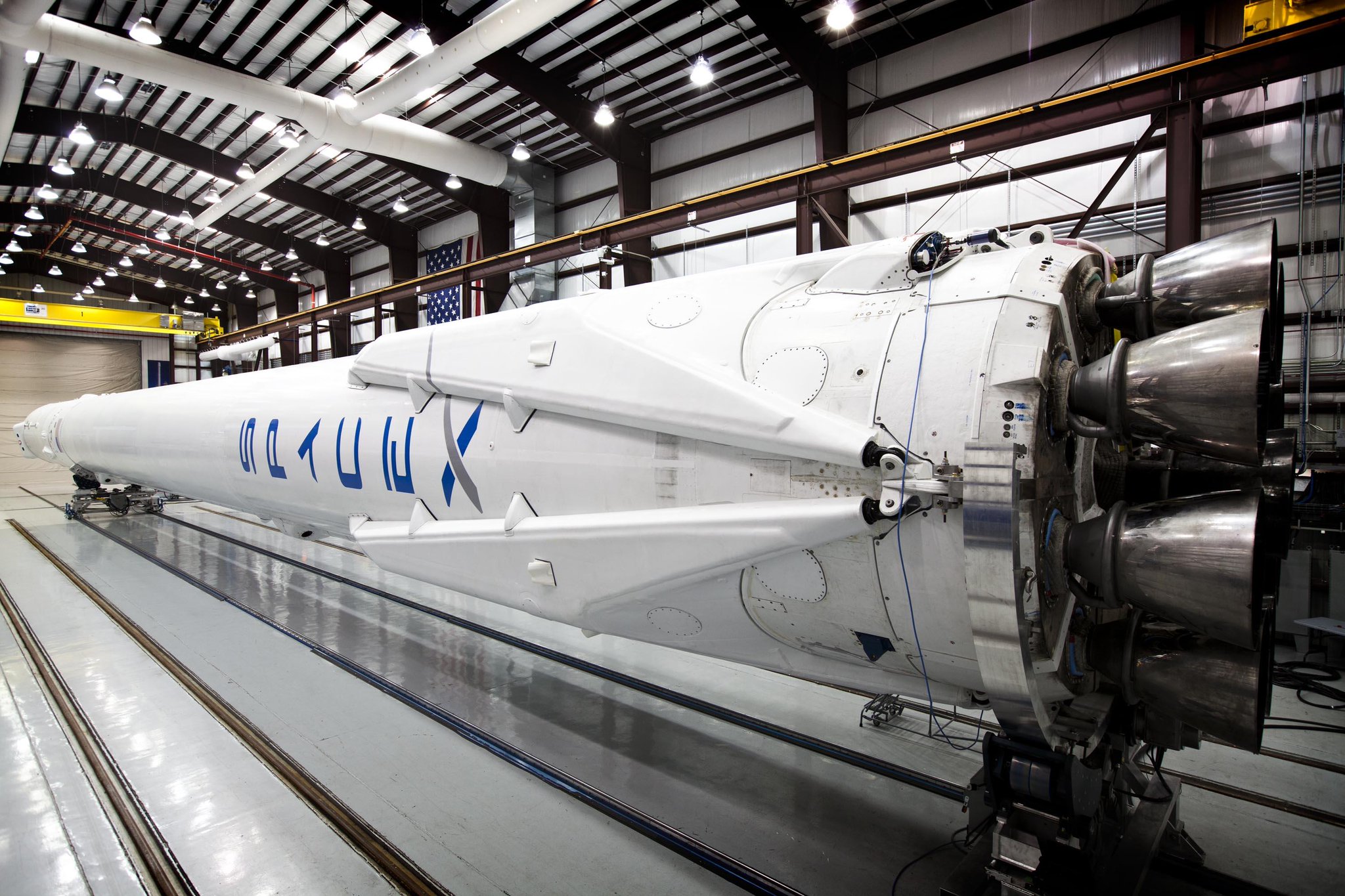
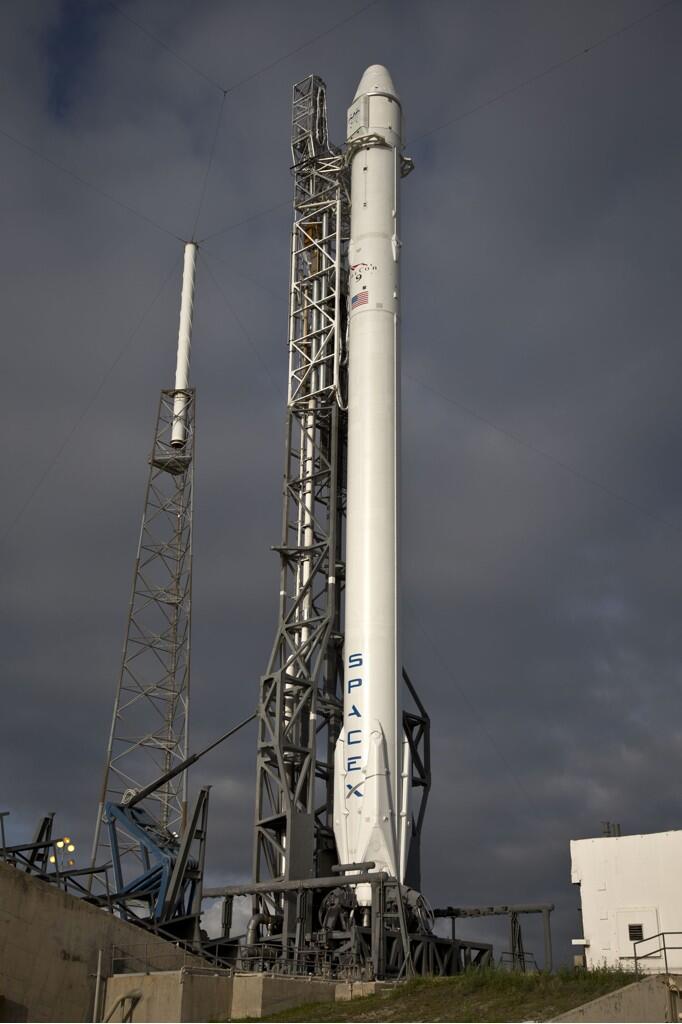

Their most recent test went pretty well all things considered. For the first time they tried a "death swoop" maneuver, turning the 1st stage 180 degrees around as it was starting to re-enter and refire some of the engines to slow it down. It picked up a nasty roll though and centrifuged the propellant, cutting the engines prematurely. They recovered some debris but that's about it.
It's hard to overstate how big a deal it will be if they pull this off. But the odds of success are very low, given the propensity of these things to tumble and roll on reentry.