> “The Canadian government needs to take a firm stand on shipping via the Northwest passage in order to safeguard the environment and to enforce Canada’s sovereignty,
This is a big deal in Canada right now. There have been a bunch of rumblings from our neighbor to the south that maybe Canada doesn't really own the islands in our north and that the Northwest passage should be considered open water for everyone.
This is troubling for a number of reasons, specifically sovereignty, mining and oil rights and most importantly shipping of oil and nat. gas through the passage. There is a bid debate going on as to what sort of cargo should be allowed to go through the passage, specifically should oil tankers be allowed.
many people want this shipping lane closed to oil tankers, some for environmental reasons, other because they've spent billions on pipe lines. The only consensus you can get in Canada is that we own the shipping lanes and therefor can control what and who goes through it.
Slightly more than 100,000 people in 3,867,271 km^2 of the 3 northern territories. (Just under half of Canada by area, bigger than India) It's going to be very hard to assert sovereignty when it's such a large area to monitor with so few people. For example a German weather station build in Labrador in 1943 wasn't found until the 1980s. Who knows what other countries are already doing in Canada's north.
These days we have remote sensing satellites, plus sophisticated software to analyze their data, so it would be quite a bit more difficult to do something big and go unnoticed.
As I understand it, the island ownership doesn't necessarily solve this; there would still be a dispute over what happens if a passage wider than 24 nautical miles opens up. Canada isn't an archipelagic state, so would not be able to make an argument for the same sort of broad internal waters that, say, the Philippines have, so any such passage would be outside of Canada's territorial waters.
There would still be exclusive rights to economically exploit, of course, but Canada would not be able to forbid international shipping through such a passage.
24 miles? in 1995 the Canadian Navy opened fire and took a Spanish fishing boat that was farther away than the 200 nautical miles http://en.wikipedia.org/wiki/Turbot_War
If the Mississippi river suddenly grew up to 25 miles wide, you can bet no foreign boats will be allowed to navigate on it as "international waters". Basically the limits are imposed by the respective naval forces.
Inland lakes and rivers are internal waters; the state they're within has absolute control over them.
Territorial waters end 12 nautical miles from the coast.
The exclusive economic zone ends 200 nautical miles from the coast.
The firing upon and seizure of a Spanish boat in international waters would, if they chose that course, have been legal justification for Spain to declare war.
I know very well the distinctions thanks, I just put forward an extreme example but the main point remains; if someone anchored a boat 201 miles off the coast of California and set up some casino or whatever activity is illegal in the US, the Navy would assault it. See also the incident with Israel attacking civilian/activist boat and killing people, including American.
Some people (like here the other day regarding the post about the guys who bought an island) think international waters are kind of sacred, the truth is that it depends on what the powerful nations want to do. Boats are routinely boarded and inspected in international waters.
So in the case of Canada actions would depend on the nationality of the ship; if it's not a nuclear power and Canada has the logistics you can bet it will be engaged regardless of 12 or 200 miles.
Saying that Canada is not an archipelago because there is a huge landmass in the southern part of the country does not change the fact that the northern part does in fact consist of an archipelago by definition:
I didn't pick up on this subtlety. Really good point. Can I ask about the significance of 24 nautical miles? Assuming that's an international boundary condition between Canadian territorial waters vs. international waters?
Territorial waters extend 12nm from the coast. So if there's a path through that's more than 24nm wide, some part of it must lie outside of Canadian territorial waters, regardless of the status of the islands.
Yes, which was why my original comment distinguished between the right to bar shipping and the right to economically exploit.
Even if Canada prevails on ownership of every single Arctic island, a passage more than 24nm wide would mean supertankers could come through, and Canada would not be able to forbid it.
That's a claim which, from looking at a map, is unlikely to hold up; internal waters are lakes, rivers, and inlets which come further in than the baseline established by the coast.
The only exception I can find is for nations which are made up of an archipelago of islands, and Canada is not one. So again, so long as there's a wide enough route through the islands, it doesn't matter what country owns the islands -- the sea passage between them would be open to international shipping.
Just looking on google maps now, there is a chokepoint across the passage that has several islands - this makes a contiguous territorial water zone (as each island is within 20 google-map-miles), if Canada's claim to ownership of the islands is respected. I assume this is why the argument is on ownership of the islands rather than route of the path.
"Canada does not have a single port along the Northwest Passage but that Russia, by comparison, has 16 deep water ports along its Arctic coastline."
The article seems to end by identifying Canada's first major problem. Then you move into things like ice breakers etc. where Russia leads, while Finland and Sweden are ahead of Canada/USA.
"Presently, 60% of all diesel icebreakers are produced in Finland, 100% of all nuclear icebreakers are produced in Russia." Meaning Finland and Russia have a big head start here... http://barentsnova.com/node/1573
You can buy icebreakers easily. We would be happy to sell you as many as you want as the global shipbuilding industry is doing extremely badly. Just last week a whole dock was shut down in Rauma, Finland.
Canada has icebreaking hovercraft - I remember seeing a documentary with footage of the driver doing spinouts in the giant machines. My first impression was that the demand for that job must be intense.
Canada doesn't have the military resources to enforce this without a corresponding increase in military budgets.
We will have no choice but to partner with the very same folks who are eyeing these lucrative areas. I guess we'll get a taste of what it feels like to be a country where to protect our resources and land we'll be forced to give some (most?) rights away in exchange for military augmentation and favourable procurement prices.
It's not so much the shipping that is upsetting it's the arrogant dismissive tone by certain countries deciding the water belongs to everyone because it's convenient for them.
When your so-called friends ignore your sovereignty and we are so small population-wise what choices do we have for defence? I know the US wouldn't stand for it if the situation was reversed.
Good luck with search and rescue too we have a tough time now finding ships and planes we know about let alone some unknown ship who knows where. The recent Coast Guard helicopter crash is a good example the ship that the helicopter came from knew where they were but still couldn't get to them before they occupants froze to death. http://www.theglobeandmail.com/news/national/three-die-in-ca...
Prime Minister Harper is putting a push on lately to visit the north but it's more PR than anything but his party has spoken about building massive Coast Guard ships to patrol the arctic in the winter. I think they had giant tracked wheels on the front to help break ice; the bows of ice breaking ships ride up onto the ice they don't push through the ice.
I guess it's useful for Canadian politicians that they can wrap things like jockeying for a cut of international shipping in both the maple leaf flag and the Canadian inferiority complex.
"Good luck with search and rescue too"
Waters you can't secure, waters you can't patrol, waters you can't provide search and rescue for...You need to be able to at least give a decent pretense of doing those things in order to board ships and demand money without being called a pirate.
I agree with you that countries shouldn't be walked over like this.
However, our territorial claims will be ignored if we don't boost funding in a navy fleet, coast guard fleet and/or ports to assist with patrolling. Unfortunately, it's easier said than done given our lack of appetite for even higher taxes which would probably come in the form of a GST hike.
It seems our options are:
1) Raise funds to patrol or enforce our territory;
2) Partner with other countries and attempt to negotiate minerals, resources or access in exchange for adherence and continued international recognition of Canada's territorial claims; or
Canada is simply too big. Infrastructure and defence are a function of the GDP divided by the area. Too small a GDP or too large an area and you can't properly wire, put roads in or defend a country. Even so, we have these borders that were agreed upon in the past, a change of the weather shouldn't cause such a border to be redrawn.
The US is the prime opponent in this battle. They are the ones claiming the right to use the Northwest Passage as an international shipping lane. In my opinion, their position is weak as there is no historical tradition of the passage being used as such. Of course, I am Canadian, so I may be biased.
At the close of WW II Canada had the world's second most powerful navy. It may not be able to take on Russia or the US, but there's no reason for the modern Canadian navy to be this weak.
When it comes to international trade, there simply is no substitute for a strong navy. Friendly relations and treaties with countries possessing strong navies can only go so far.
We're talking shipping that's not coming from or going to Canada. According to Canadians in this discussion, we're talking about that shipping going through remote, unsecured areas where the Canadian government struggles (or fails) to provide services like search and rescue.
All fringe interest in banning shipping through these waters aside (as Canada will not actually do that), the Canadian claim here seems to be a naked grab for money. It can't provide services in that area and it can't meaningfully regulate shipping activities there. All it can do is sit at a few choke points and collect fees.
I'm guessing what will happen is that various companies will propose building ports in the Canadian north, and Alaska. Then there will be debates about levels of investment and ownership and preventing oil spills and so on.
Similar debates have happened with respect to developing Canada's oil and potash resources (in the interior). I don't see the need for the military to get involved.
As far as I understand no foreign countries laid claim to Canada's oil and potash resources in the interior. The difference for the Canadian North is that we have a few countries disputing our territorial claims[1] such as Denmark (via Greenland), Russia and the US. Thankfully these disputes are contained within diplomatic channels.
My point is not that we must go to war, but that if we expect other countries to obey our laws typically the best way of enforcement is an actual show of force via patrols.
Ironically, as I read about the Canadian Coast Guard, it is one of the few coast guard services that has a strictly civilian mandate with no military nor law-enforcement responsibilities[3].
> arious companies will propose building ports in the Canadian north, and Alaska.
I don't think so, because those ports won't be ice-free, and will therefore be of little use.
Valdez (the end of the AK pipeline) is the most northerly year-round ice-free port, and it's not North at all, by AK/Northern Canada standards (I have to drive many hours South to get there...)
Actually I would like to put forward a counter point that is does have the capabilities to enforce it. They could put the pressure on the US and EU through the WTO by threatening to cut off oil sand exports (which is already being disputed in public with the EU), Canadian wheat, and logging exports.
Canada could bargain with the US and seek to get backing for their EE zones and counter any claims by EU states. Canada and the US already have a close military relationship and the trade between the two countries is larger than any other trade between nations at ~$300B USD thanks to NAFTA.
Military warfare is a thing of the past when it comes to nations of our size and strength and what it would do to both. Economic warfare is the new way that Canada can fight.
Canada could do that. It'd be profoundly stupid, as Canada would be hurt far more than the US and EU would be. (On the US/EU side, prices would go up, with eventual repercussions. On the CA side, no money would come in for those export industries, and you'd quickly have tons of people laid off and those companies clamoring for government assistance.)
But yes, Canada could do that in hopes of getting a cut of potential future shipping money. Their politician probably aren't that foolish, though.
I would think that any nation calling it "international waters" is going to cause a lot of problems. Now that doesn't mean they should tax anyone that passes through, but fishing and port rights will obviously be part of it and there will probably be an agreement made through organizations such as the G8 or WTO to counter any threats to that exclusivity.
Basically it's just going to be negotiation time and Canada will come out the winner. IMHO.
Edit: why on earth was I down voted? Err, whatever. Sorry for my fact-based opinion. Loons.
There are only a small number of countries that consider the entire Arctic to be national/internal waters. Most of the world, including the US (http://www.parl.gc.ca/Content/LOP/researchpublications/prb05...) and all of the EU other than Denmark and Norway, consider the Arctic to be international waters.
In this particular case the coal was being shipped from Canada, which benefits Canada, who happens to claim to own much of the Arctic. Presumably ships carrying Canadian cargo would be cleared to use this route, and legally be required to seek such clearance in order to be cleared to leave Canadian port. Other ships which do not leave from, refuel at, or stop on Canadian land, would presumably be asked to seek permission to pass through what most of the world considers international waters. There are only certain countries that would even want to, but it would obviously be useful for China, Japan and Korea to use this route for shipments to Europe.
Eventually someone will take the route without permission, and then Canada will need to figure out to what extent they can assert their claimed ownership of the Arctic.
Should Canada succeed in their claims internationally, it may be a good opportunity for other countries to make use of the new doctrine as well. For example Somalia has long claimed that ships going through the Suez canal are passing through their territory, and other nations claim that these are international waters not subject to Somalian boarding for inspection and collection of fees (which other countries call piracy). It will be interesting to see if Canada prevails in its Arctic claims, while maintaining Somalia has no similar claims to control of what they consider national waters, which don't extend anywhere nearly as far from land as Canada is claiming here.
> Should Canada succeed in their claims internationally, it may be a good opportunity for other countries to make use of the new doctrine as well.
To be fair this statement is pretty inflammatory.
There is no new doctrine. Canada has always claimed they owned these island and no other country has ever disagreed with this(1), until the past 20 years or so when oil was found under the water and the north west passage started to open up.
And to be clear, Canada has claimed ownership, of these islands since 1880, so this isn't exactly a fresh land grab:)
As can be seen from this diagram, any ship going through here sails directly through Canadian waters.
(1) with the exception of Denmark and hood island. However here both countries disagree about which side of their territorial borders a small island lies on.
Again: it's not about the islands, it's about the water between them.
Let's stipulate that Canada owns every island in the hemisphere. Now what? If enough ice melts that there's a passage between them which doesn't come within 12 nautical miles of an island's coast, then there's a passage that isn't in Canada's territorial waters, and Canada can't, under current international law, forbid ships using the passage.
For the passage in the wikipedia diagram, both of the two paths after the first bifurcation (moving westward) pass through channels less than 24 nautical miles wide. Canada would need to build observation towers but it could be defended with "cannons" e.g. the M777.
>For it to not constitute piracy, it should happen within 12 miles of their shoreline, their territorial waters.
i somehow don't see how actions of Somali pirates wouldn't be considered as such even if it happened inside the 12 miles zone. Piracy inside or outside of territorial waters is still a piracy.
Compare that to a hypothetical situation - if Somali could gather a presentable navy and start harassing ships outside of the 12 miles zone and a presentable looking spoke-person would communicate some theory why it is a right of Somali people - then we'd have just a legitimate territorial dispute :)
>Somalia has long claimed that ships going through the Suez canal are passing through their territory
Huh? How could Somalia possibly claim this? Seven other countries' coastlines stand between the Suez and Somalia. There is nearly a 3000km distance between the Suez and Somalia's closest border.
Somalia has long claimed that ships going through the Suez canal are passing through their territory
The Suez Canal is half a continent away, and completely bounded by Egypt.
The tight point of the Bab el Mendeb, where it narrows to about 20 miles, is between Yemen and Djibouti anyway. Where Somalia is, the Gulf of Aden widens out to around 150 miles, of which only 12 miles are recognised as territorial waters, same as everywhere else. I am not a shipping expert though, this is not shipping advice.
There's also the point that shipping has been using the strait for as far back as we have records. The same can't be said of the Northwest Passage.
The important thing isn't the crossing, it's not needing to be accompanied by an icebreaker. The oil tanker SS Manhattan [1] made the trip in 1969, but unassisted crossing makes this economically competitive.
This is the first thing that crossed my mind when I even read the title. This is a sad thing and I don't think it is a cause for celebration. Next up, oil platforms in the Arctic.
The sad thing is that, apart from whatever feedbacks are there in the environement, there are far to many economic feedbacks pushing our civilization towards greater environmental destruction.
Do you think there will such a furore over Canadian tar sands, when the oil from the middle east comes to a trickle ? When the fertilizer plants stop, plastics manufacturing ends, and transporting coal becomes harder ? Should governments care for the Earth or its subjects ? I'm sorry for being so dystopian, but I don't think Science has the ability to bear the burden of, what will be, 10 billion people. This will happen sometime, I just wish I'm not alive to see the day; climate change makes it much worse.
As far as I know, they could only have used Iridium satellites for communications. All of the alternatives that I'm aware of have satellites on geostationary orbit, which makes it impossible to cover anywhere outside 80 degrees North and South, whereas Iridium has 75 (originally 77, one failed, another collided with a defunct Russian satellite) satellites on the polar LEO orbit that covers literally the whole earth.
Iridium constellation consists of LEO satellites which have an orbital period of less than two hours.
If they're anything like the ones I know, it depends on the particular day and particular discussion. There is no one stance on climate change, just a general contrarian theme. If the discussion leaves room for doubting warming in general, that will be done. If too much evidence for warming is presented, it'll switch to doubting human causes for it.
It's true that the more aware deniers updated their propaganda 5 to 10 years ago with the non-anthropogenic argument. But there are still a lot of less informed deniers that swallow the hardcore right-wing conspiracies whole. i.e. there is no warming, it was invented by Al Gore to take away our freedoms and establish a one world government.
Real climate has disproved all models to date. There has been no forthcoming explanation for the 15 year hiatus in warming. In other words the science underlying climate is far from known. As Feynman reminds us “It doesn’t matter how beautiful your theory is, it doesn’t matter how smart you are. If it doesn’t agree with experiment, it’s wrong.”. Thus we have to push on and cannot advise politicians.
Since 1979 the IPCC report has published a best estimate for the climate sensitivity. Its latest report says "No best estimate for equilibrium climate sensitivity can now be given because of a lack of agreement on values across assessed lines of evidence and studies.".
It is not a question of denying or conspiring. It's a matter of discovering the science behind our climate. Let's do it without the silly rhetoric.
By the way, if you believe the very worst prediction (proposed on the basis of failed models) then you will be interested in this link which asks what the cost of 'doing something' is. http://topher.com.au/50-to-1-video-project/
You'll note that the article carefully doesn't link to actual data showing the amount of heat that has actually been "trapped". (No, the IPCC report is not "data". I'm talking about actual data sets that are archived on publicly available servers with cryptographic signatures to ensure that it's complete and intact. You know, the sort of thing that is routine when you're downloading a piece of code, but which the climate science community has decided is much too difficult for data on which they want to hang the fate of the planet.)
Reading between the lines, their numbers for "trapped heat" are based on computer models, not on actual data; what they're basically saying is "the only data we have doesn't show the heat, but our models say it should be there, so we assume it went into the oceans".
I refuse to believe it without checking it, yes. (I noted somewhere upthread that there was a link to a GRL paper that might shed more light on the details in this particular case.) I take the same attitude when I read a claim about physics. I don't accept arguments from authority, and that's what "actual scientists are saying it" is. Actual scientists can be wrong. So can I, but that doesn't mean they get a free pass.
That's because they carefully picked 1997 as the starting year. What does the trendline look like if you pick other starting years?
More generally, why do we assume that a linear trendline is the appropriate way to analyze this data? Has anyone actually done an analysis that doesn't start from that assumption?
Thanks for the links. I at least see why the second graph had to pick 1880 as the starting point, since that's as far back as the instrumental record it used went. And at least it considered the possibility of a non-linear fit.
However, the curve fitting is still subject to error, because you don't have the trend before 1880, at least not in this dataset. What if the temps around 1880 were anomalously warm compared to, say, 1800? (Which we have reason to believe they were.) Then the actual trendline from 1800 or so might still be roughly linear.
But more importantly, 1880 is still an arbitrary starting point; any starting point is arbitrary unless you know you have the entire dataset, which we obviously don't. If the actual trend is, say, a sine wave with a period of roughly 800 to 1000 years, with the last peak being around 1000 - 1200 AD and the last trough being around 1600 - 1700 AD, what we're seeing now could just be the approach to the next peak.
I note that the article links to a GRL paper, which I'll have to read; its abstract doesn't make it quite clear what is actual data and what is extrapolated from models.
Top graph is slope of a linear trend line for the 15 years prior to each indicated year. Bottom graph is the underlying temperature data.
For 30 of the 15-year blocks the trend was negative; for 88 the trend was positive. The last year in which there was a linear cooling trend for the 15 years prior was 1977.
You could, but to be intellectually honest, you could only use that argument if you yourself would be convinced that no shrinking of the sea ice was evidence against global warming.
Belief in global warming can really only come down to belief in the experts, especially the IPCC. My understanding is that the most important evidence is global temperature trends. This is (and should be) analyzed very critically since the data is very complex and suffers from many issues. However it seems that the debate has already been won.
Belief in global warming can really only come down to belief in the experts, especially the IPCC.
Let's transfer this claim to another domain: "Belief in how to best organize our economy for prosperity can only come down to belief in the experts, particularly Wall Street investment bankers." Does it still seem reasonable? (And, btw, I suspect you may not have meant that you think belief in the experts is a good thing; if so, I'm giving another reason for not thinking it is.)
Also, it's easy for people to believe in experts that say things they want to hear; not so easy to believe in experts who say things they don't want to hear. How well are the experts in biology doing in convincing creationists to accept the theory of evolution? (Which, by the way, is much better supported scientifically than any theory about how the climate works.)
The plain fact is that you can't trust experts. You can't trust anyone. You also can't verify every single fact for yourself. There is no magic formula that will guarantee that we can get the right answers.
There may not even be any right answers. With regard to climate change, even if we accept for the sake of argument some particular set of predictions about how the climate will change, there will still be plenty of disagreements about whether that change is good or bad. China and India don't seem to care much that they are pumping CO2 into the atmosphere by building new coal-fired power plants like gangbusters. If we in the US decide to emasculate our economy in order to "prevent" global warming, all we may end up doing is making ourselves into a much poorer country while China prospers.
Experts in climate change are not obviously biased in the same way as investment bankers might be. They do not profit directly from the outcome of their recommendations, and they are in principle paid by the government to be objective.
That said, any set of beliefs can be self-reinforcing, and I was initially skeptical of global warming because there are strong incentives to toe the official line. I'm sure that many researchers keep on playing with their data until they get a "result" i.e. evidence for global warming. However there has also been a lot of outside scrutiny, and I also think that in spite of this bias, academia also has the ability to be self correcting.
I've never heard any argument that global warming might be good. China and India both recognize the importance of CO2 emissions. However, they claim that since their per capita emissions are lower than the West, it is the West who should reduce their emissions first. They claim that any global cap-and-trade system should be based on per-capita quotas.
Experts in climate change are not obviously biased
...square with this?
there are strong incentives to toe the official line
Doesn't that equate to bias, at least in practical terms?
They do not profit directly from the outcome of their recommendations
They most certainly do. Recommendations that there is a big problem that needs lots of analysis lead to secure jobs and political power for the scientists doing the analysis. Recommendations that "there is nothing to see here, move along" don't.
they are in principle paid by the government to be objective.
Perhaps they are, in principle, though I would argue that that isn't really true. You can't combine scientific objectivity with a political agenda, but that's exactly what government funding of science does.
academia also has the ability to be self correcting
This is certainly possible, but it's not easy, and the mechanism by which it happens is thwarted by claims of "consensus" or that "the science is settled".
I've never heard any argument that global warming might be good.
You have spewn out a lot of garbage above, and I'm not going to bother replying to all your points. The once point that was valid was
>They most certainly do. Recommendations that there is a big problem that needs lots of analysis lead to secure jobs and political power for the scientists doing the analysis. Recommendations that "there is nothing to see here, move along" don't.
This is indeed a significant bias. First, there is also an incentive for disagreeing with the mainstream since people with other political views or agendas are willing to fund it as well. I can't remember the name (google might be your friend here) but there was a group of skeptics who reanalyzed temperature data so as to better account for heat islands. They ended up confirming global warming. Second, while as a group researchers benefit from belief in global warming, an individual researcher could do very well from finding convincing evidence against global warming.
These are all reasons why in spite of this bias the conclusions of mainstream researchers are probably valid.
there is also an incentive for disagreeing with the mainstream since people with other political views or agendas are willing to fund it as well
This might be an incentive for scientists to serve other political agendas, yes. (Though it's not much of an incentive unless those other agendas have a realistic chance at political power.) But it's not an incentive for scientists to be more objective; it's only an incentive for them to be biased in a different direction.
while as a group researchers benefit from belief in global warming, an individual researcher could do very well from finding convincing evidence against global warming
I'm not sure they could; at any rate, I think it's a matter of opinion, and opinions are going to vary widely.
These are all reasons why in spite of this bias the conclusions of mainstream researchers are probably valid
No, they're not. None of these reasons have anything to do with whether the mainstream conclusions are valid. That was my original point in this subthread: to know whether or not the conclusions are valid, you have to actually look at the data and the arguments based on the data. Trying to figure it out by looking at who is biased how doesn't count.
Also, there's a bait and switch here regarding what "mainstream conclusions" we are supposed to accept. Are we supposed to accept that (1) the climate is changing? Are we supposed to accept that (2) the direction in which it is currently changing is a warming direction? Both of those claims strike me as fairly obvious.
Are we supposed to accept that (3) the IPCC's predictions of what the climate will be like in 2100 are reasonable? I don't think anybody knows enough about how the climate works to say that.
Or are we supposed to accept that (4) we have a planetary emergency and if we don't take drastic action now to keep the climate from changing, we are all doomed? I think that's wrong, and worse, it's dangerous, because acting on this recommendation will squander huge amounts of resources that could be better spent on (a) bringing more people out of poverty, and (b) making it easier for the entire world to adapt to change (climate or otherwise).
Much of the furor over climate change is people talking past each other: people who hold opinions like the ones I've just expressed on #3 and #4 are accused of denying #1 and #2, while people who are only trying to argue for #1 and #2 are accused of arguing for #3 or #4. That makes it almost impossible to have a discussion in which #1 and #2 are reasonably common ground, while #3 and #4, which are the claims that are important if you're trying to decide what to do, can be rationally disputed.
There is a difference between Amundsen a seasoned explorer making the passage in a tiny 46 ton ship by hugging the coast and dodging ice and a 75 THOUSAND ton ship making the trip.
I'm curious what this will mean for international shipping as a whole. Not having to transit the Panama Canal means freighters are limited in size only by the dimensions of their ports of call. That alone might make the Northwest Passage attractive even for those routes where it's not the shortest path.
Keep in mind that the locks of the Panama canal are getting bigger. By 2015 a new set of locks will increase capacity of the canal and also allow ships that are up to 60% wider (55m), 33% longer (427m), and with 45% deeper draft (18m) to pass through.
Granted, even that size is not large enough to accommodate a monster like a Maersk triple-E class container ship (which is 59m wide and has too deep a draft to dock anywhere in the Americas), but the vast majority of the largest container ships in the world (see: http://en.wikipedia.org/wiki/List_of_largest_container_ships) will fit (91 out of 100 by my count). Whereas none of the ships on that list could pass through the current locks in the Panama canal.
I realize you mentioned this, but there would be ships bigger than New Panamax[1] and if nothing else a Northwester Passage might mean that more larger ships get built.


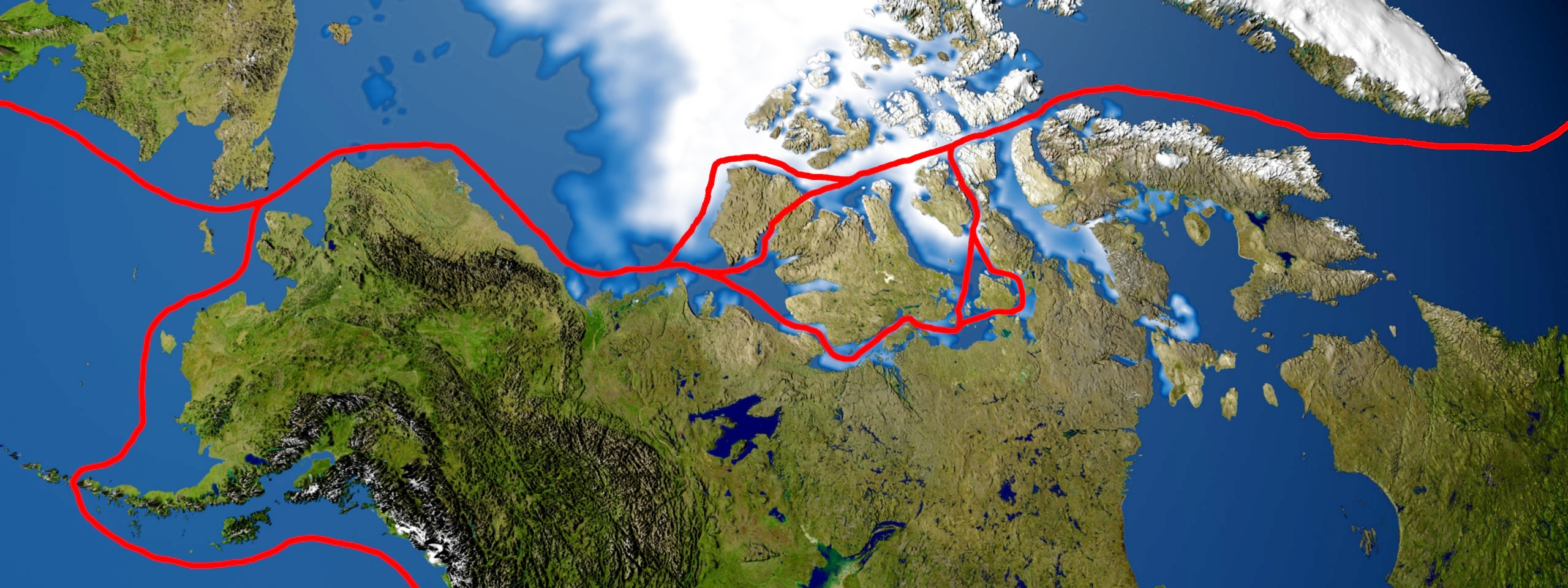


> “The Canadian government needs to take a firm stand on shipping via the Northwest passage in order to safeguard the environment and to enforce Canada’s sovereignty,
This is a big deal in Canada right now. There have been a bunch of rumblings from our neighbor to the south that maybe Canada doesn't really own the islands in our north and that the Northwest passage should be considered open water for everyone.
This is troubling for a number of reasons, specifically sovereignty, mining and oil rights and most importantly shipping of oil and nat. gas through the passage. There is a bid debate going on as to what sort of cargo should be allowed to go through the passage, specifically should oil tankers be allowed.
many people want this shipping lane closed to oil tankers, some for environmental reasons, other because they've spent billions on pipe lines. The only consensus you can get in Canada is that we own the shipping lanes and therefor can control what and who goes through it.