I have two friends who work on this for Rio and the level of tech is amazing.
Even the manned trucks have their routes all planned by computer. Some algorithm decides the most efficient way to move trucks around. Sometimes a driver will get a seemingly nonsensical instruction to deposit his load in a location other than the one closest to him, but when you query the computer about it, it's got a valid reason why that's a better idea for efficiency and it's always right.
The precision in the GPS trackers in phenomenal. Short range scanners pick up GPS tags on all corners of a bin, a robotic delivery system can place a gigantic item with mere centimetres of accuracy.
The human really is the weakest link in the entire system.
It's unsurprising the military want this. I remember being an outside contractor for PermoDrive in the early 2000s. They were just a small company from a small rural Australian town who developed a system which enabled trucks to store braking energy and later use it as forward momentum, reducing fuel costs by some large amount. Once they had a working prototype, the US military swooped in and bought the company.
Wikipedia article [1] states that differential GPS can provide up to 10cm accuracy.
Differential GPS works by having a local GPS receiver station which location is well known. This station is comparing the location determined from the GPS signal to its known location, calculates necessary corrections and sends the information to other GPS receivers.
You are incorrect. It's quite possible to achieve sub 10 cm level accuracy with an RTK based GPS system [1]. The problem is that you have to install base stations to gather the corrections and then have the radio towers to distribute them. Since mining sites are fixed locations, it's pretty straight forward to setup up the needed infrastructure for an RTK system.
I think they use local calibration. You have a GPS receiver at a known, surveyed point onsite. You compare the GPS placement to the actual location of the receiver, then use that difference for calculations being performed on other receivers.
This reminds me of programming the lego nxt robot to move foam blocks for a college robotics class. Amazing what algorithms can do with the right hardware!
My Dad worked on this tangentially for a while, helping set up and maintaining the communications systems.
Rio is also automating their trains, and minesite operations (a kind of "flight tower" for a minesite) have all been done remote for years. It looks a lot like an NOC, actually.
Finding people to drive trucks for 100k+ is actually not that hard. You basically advertise a job: "drive trucks. Make big bucks" and people flock to it.
But getting 2 or 3 different people to drive the same truck in shifts, and accommodating them, and flying them in and out, and feeding them ... it adds up. To an overhead that could run past a million dollars per year, per truck. And if you have an idle truck, that's lost money.
But it's not even the money. Rio, like BHP Billiton, enjoys insane free cashflow right now.
It's about protecting production from union activity.
In the 80s the Western Australian mining industry was repeatedly crippled by huge fights between the mining giants and the unions, particularly the quite-militant CFMEU. A mix of legislative changes by a long-serving conservative government beginning in the mid 90s, plus generous individual contracts, broke the unions' grip on mining. And just in time for the mining boom.
In 2007 a Labor government was elected and dramatically tilted the legislative tables back in favour of the unions. Then the GFC struck with full force and it so happened that Rio had just prior to it borrowed heavily to buy assets at the top of the market. So any prolonged interruption to production would be death.
And so Rio have moved to make their mining operations as union-proof as possible. Automatic trucks is part of it. The ore trains too, parts of their port systems ... everything that can be made autonomous and/or remote is being made autonomous and remote.
And for the Australians reading you can realize that Australia is toast if it doesn't get its act together and put in a real mining resource tax. You can't just rely on employment from mining. The country's resources need to enrich its people, not just foreign investors. Otherwise you're just being robbed right before your eyes.
That's what I was thinking as well. If Australia doesn't have proper taxation of "insanely profitable" mining companies (paraphrasing), worrying about unions seems like misdirected effort. Norway has a 78% tax on profits from the petroleum industry, and the oil companies are thriving quite well. You can't exactly outsource the mining industry.
In fact, extremely heavy taxation will help with the "problem" of unions because with heavy taxation, the mining companies wouldn't have an incentive to penny-pinch on salaries. And with higher salaries, a greater amount of the mining wealth would be evenly distributed and enter the economy where a larger number of people can spend it. This is what happens in the North Sea. As a bonus, the unions will to a greater degree spend their efforts of safety measures instead of a game of tug-rope when it comes to salaries. The Norwegian model works.
Of course, you can't just tack on a 70+% tax regimen in retrospect without confiscating enormous shareholder value. So I think Australia is more or less screwed on this front. The best you could do would be to progressively tax new minesites. But of course this screws up the incentives unless it was done from the start.
True, but there are some differences. The PRRT only applies offshore, where the resources are owned by the Commonwealth, not states. So there's no need to dance around state royalties.
The second difference is that Hawke and Keating didn't just drop it like a bombshell. They took their time to talk it through with the industry, over I think it was about 18 months of consultation and negotiation.
Finding qualified people to drive these trucks are actually quite hard. There's a lot of misconception that you can apply for these jobs and start making $150k+ immediately (and somewhat the media helped fuel that perception). The applicants need to show both qualifications, and more importantly, experience. And the vetting process is very rigorous.
I have a friend who drove mining trucks in a Copper Mine in British Columbia when he was a student. He told me it was the most mind blowing boring job except for the time he almost fell asleep and drove it over a cliff. From his description, it didn't sound like a particularly high skilled job - but perhaps the type of Mine he was in had a different type of truck system.
'Vehicle and driving' are actually one of the major risks in mine operations, for the reason you just described. Fatigue, overconfidence, complacency, or simply momentary lapse in focus can lead to dire consequences.
There are controls put in to ensure safety (e.g. cabin sensors to detect signs of driver fatigue, in-vehicle monitoring, vehicle blackbox, etc.), but at the end of the day, it can only help so much.
Driving the trucks in a sane way and not flipping them over while turning is actually so boring that it is hard to find people who can and will do it and still get good productivity, at any pay rate.
Source: Brother in law was a foreman at a strip mine.
It wouldn't all be unions, there are other factors. Not least of which being the autonomous trucks will produce more tonnes more quickly, with less costs and better safety performance.
The OH&S benefits alone would have justified the project in the long term, and not parking the truck up justifies it in the short term - even without any existential threat from the unions.
As an aside, was there any threat of union activity? I haven't followed WA industrial relations in the last 5 years, but I though the operators have been too busy wallowing in cash to worry about pay.
The big pay has helped a lot, but unions now have much greater powers to stop a site for various reasons. Including OH&S.
I agree that there is more than one reason why Rio is doing this. But from a business perspective they are more vulnerable to production interruptions than BHP -- who aren't carrying such a heavy debt burden.
Is it a problem that unions have the power to stop the work for safety reasons? On the contrary, I believe that this is a necessity if you want to preserve the value of human life under dangerous work.
I am currently reading about the history of the North Sea subsea workers during the great petroleum expansion from 1960-2000, and the safety culture which followed from American drilling companies was just atrocious. Divers would be forced into lethal working conditions in situations where it was completely out of proportion to the importance of the work. 16-hour shifts under water, aggressive decompression tables which frequently led to both acute diving sickness and long-term delibitating injury, in addition to frequent accidents. (An "accident" under water usually means death). One time they sent down a guy who had been picked up from a pub three hours prior, who started the dive by puking in front of the whole crew. He died.
So tl;dr, giving unions the power to temporarily stop the work for safety concerns is vital if you want to make sure that the workers mostly get home safely.
I'm not saying that it's good or bad. I'm saying that from the POV of production, a stoppage is a stoppage, regardless of what caused it.
If you improve safety by removing humans from dangerous situations, you reduce interruptions to operations. For a company at the scale of Rio, that's millions of dollars per day.
No question that it's a good idea to get people out of harms' way. But on principle, I think that the "ethics-neutral" view of "a stoppage is a stoppage" has caused a lot of injury and death over the years. You can say that this view isn't good or bad, but if it is applied to human workers the result will definitely be bad.
What causes injury and death is defective safety systems and poor safety culture. This is true of any dangerous enterprise, whether operated for profit or not.
You'll see defective safety systems and poor safety culture a lot more often in unregulated, for-profit businesses than in union- or government-regulated businesses. I don't think you'd need a scientific study to verify this claim. I mean, the whole point of regulation is usually to improve safety.
As I understand, they're controlled, but not driven. Basically a controller lays a path and the truck drives it autonomously; stopping for hazards, unexpected situations and so on.
I work for a company in Utah that makes kits to convert single-person driven vehicles (e.g., cars, trucks, motorboats) into autonomous vehicles (http://kairosautonomi.com/).
One of our projects this last year was with a mining company in Russia (http://www.belaz-mining.com/eng/belaz/30t.html / Russian video of our trucks http://auto.tut.by/news/autobusiness/346004.html). At least one of their mining areas is highly irradiated. The radiation is so high that drivers reach their life-time radiation limit in about 6 months of driving. So they're automating their fleet of trucks to avoid the need to constantly replace drivers.
Both the autonomous mining trucks [1] and the automated military convoy run on software developed by NREC [2] (a part of the Robotics Institute at CMU), and I have worked on both. It's a very cool place to work and we are hiring. If you have any questions about what it's like to work on these kind of systems ask away.
Ah, I would love to work on such projects. What is a real barrier for me that most of these jobs require US citizenship or permanent residency, which I don't have the luck to show. I do understand that these are strict requirements because of the export control laws. Since you are in the industry you might know if there is any place where you can work on autonomous vehicles without being a US citizen. Maybe somewhere where they work on civilian applications? Or a comparable lab/company in europe?
One of the advantages of an academic institution like CMU (which NREC is part of) is that they actually have a good deal of commercial work which doesn't require US citizenship. For example the robotic mining project is shown here is not export controlled, and neither are the agricultural projects [1].
So it looks like Rio Tinto is using Komatsu's system and BHP Billiton is using Caterpillar's. To my knowledge NREC only works on Caterpillar's system, it's just a coincidence the systems have the same name.
> The company also claims it can be more productive with the trucks — it’s more expensive to hire drivers and handle the logistics of moving them back and forth from the iron mines.
Followed by:
>But the reason why the technology is picking up in the mines is partly out of necessity. Partly because Rio Tinto can afford it.
Let's face it. Anything to not pay pensions and workman's comp.
Hey. I'm an Australian Mining Engineer, (co-incidentally employed by Rio Tinto, although obviously I'm no spokesperson and have no idea what the higher-ups are doing, or even blokes on other sites). While I don't have any knowledge of the autonomous truck project, pensions & workman's comp have basically nothing to do with it.
The mining industry in Australia is on the tail end of the biggest expansion in living memory, and it turns out it is near-impossible for love or money to move Australians out into the desert to work in mines.
It was not unreasonable to have trucks parked up because there simply was no human to drive them, and the salaries for a truck driver were in the $150,000+ Australian dollars, plus food, lodging and plane flights. This doesn't represent a scary cost for a mining company - it represents a scary lack of worker supply. A parked truck is an unhappy truck.
In addition, we have very strict OH&S laws and the site mangers can be raked over the coals for the wierdest things. Eg, if I saw a light vehicle parked on non-level ground without wheel chocks, it would probably be escalated to the site Manager (not a pit supevisor, not the Manager of Mining, but the person responsible for the entire site) and someone being sacked would be an option on the table. Getting rid of the humans is a huge benefit from a safety perspective, which we take very, very seriously.
Finally, automated trucks will provably do the right thing, all the time, without getting fatigued or taking breaks. Humans just cannot compete from a utilising-the-very-expensive-asset-properly point of view.
Everything I heard indicates this is not true. A hand at the mines is a dime a dozen. Engineers are perhaps another story. But the myth that you can show up at the mines and make $150k was busted a while ago, especially now as the broader economy suffers and unemployment continues to rise.
What the GP comment meant that the robots won't deviate from the parameters.
Contrast this with a human operator, who are instructed to drive at specific speeds at each road section. Perhaps due to fatigue , overconfidence (e.g. I drove on this road 1000's times before, I know what I am doing), or other factors, the driver did not slow down enough and subsequently accidents occur.
> Let's face it. Anything to not pay pensions and workman's comp.
Yup. All innovation is really just a way to screw over the honest, hard working individual. From the mechanical loom to the automobile to electronically switched telephone networks, all innovation in the modern era has been to screw over the worker.
You and me, let's start a society that gets rid of all those horrible, unemployment-inducing contraptions. Imagine - we will have 0% unemployment because all of the machines will be humans!
The graph of gainful-employment vs. technological-efficiency is not linear. It first increase, then has a hump, and goes down from there.
Eventually you get two groups -
A few highly skilled and specialized people that design, maintain, and improve the automated systems.
A large amount of unskilled workers, who are nothing more than "replaceable units", that get told what to do by those systems.
And that does not even attempt to even show the amount of unemployable people that would be around from all the human jobs lost in the first place after the hump. Just think of the fast food industry, and how technologic improvements would "disrupt" it (by removing the work force). And then who do you sell the product to? The person who does not have a paycheck?
Uh, sarcasm miss? Oh_sigh was taking the "full Luddite" tack (I believe sarcastically).
It is absolutely true that not needing to pay pensions or workman's comp is a part of the move to technology. But total jobs available goes up with increasing technological use while creating localized labor displacements.
as far as i know, unemployment has been fairly steady since the beginning of time. as new technologies come about, new jobs are created to replace the ones taken by machines. we're losing truck drivers at an alarming rate, but never before has there been so many designers and environmental consultants and political analyst jobs. it sucks if you're a truck driver, but doesn't really change much for global economics.
Companies do not pay pensions. That is left to a mix of a government-paid pension and individual retirement savings accounts (superannuation). Saving for retirement in Australia is compulsory.
As for workman's compensation, Rio have the best safety record of the majors. They have a fairly unyielding OH&S culture. My old man needed dozens of tickets to do his work. He'd need to justify climbing a ladder and log it.
Meanwhile, over in BHP, somebody seems to die every few months.
In the North Sea, you're not allowed to lift anything heavier than 40 lbs by hand (you need lifting equipment/machinery). These rules are there to ensure that workers can't be forced to do dangerous work. You said it yourself; having strict safety procedures leads to fewer deaths.
And climbing a ladder can be more dangerous than you'd think. Imagine it's a 10-meter ladder on top of some tall-ish structure. Falling down could easily cripple or kill you. The only reason this seems like a stupid safety measure is because people do it in civilian life all the time, without thinking about the (small but serious) risk. Such risks are things you see all the time when operating at scale.
You're not thinking at the right financial scale. A Caterpillar 797 haul truck costs in the range of $5 million USD (not including delivery to remote Australia). Sounds expensive, right? Well it's paid for within 4-6 months of being put into operation. So worker salaries, pensions, etc. for the driver are a minuscule portion of the money being made from a mine. There's no reason to stiff them.
did you ever consider that removing people from harms way is a good thing? Even it means their job is lost? People can be retrained, reanimation is a bit much.
These are very hazardous work sites and these vehicles are bit unforgiving. The day we don't send people down in mines will be a good one, if it starts with the trucks up top then so be it.
Pensions should be paid by the government, not private companies. In this case, everything is clear: companies are trying to be as efficient, as possible (for example, by reducing labor costs), pay taxes which will be distributed by the government for the social purposes (pensions).
Australia's employer-funded pension system has meant that we have around 1.5 Trillion in fully funded retirement funds which have decreased infrastructure funding costs locally and are invested internationally making Australia's superannuation sector a major player in international investments.
The government can't be counted on to fully fund retirement benefits without pillaging the pile of cash, as the example in most American states shows.
It's a brilliant idea and has been extremely successful.
Am I the only one being reminded of the Dune spice harvester or sandcrawlers?
"A large (often 120 meters by 40 meters) spice mining machine commonly employed on rich, uncontaminated melange blows (often called a "Crawler" because of a bug-like body on independent tracks)."
https://en.wikipedia.org/wiki/List_of_Dune_ships
"Spice harvesters are large vehicles specialy designed to harvest the Spice Melange. Because of the rythmic sound they make, they are regularly eaten by Sandworms. When Muad' Dib asked Liet Kynes if they would see a sandworm while veiwing the spice harvesting, Kynes replied that they always come when they hear a spice harvester."
http://dune.wikia.com/wiki/Spice_harvesters
When war becomes unmanned for the attackers, this world is going to become an incredibly terrifying place.
Can you imagine the warmongers when there is little human cost and all you have to do is cut funding education or assistance to the poor to attack another nation?
I really hope we get mandatory draft in the USA before this decade is out, it's the only way to stop the madness. If it becomes delegated to people sitting in trailers flying armed drones being yelled at to fire upon possibly innocent civilians, we are doomed.
It's already too late. The US military trains more drone pilots than fighter pilots. The undeclared drone war in pakistan has killed over 2000 so far. The future has come and gone.
When I was at a GPS shop in '99, the back lot already had Case and Cat farm and mining equipment in fully-autonomous mode. The challenge being worked on at the time was handling traffic between vehicles. The other one was that having non-controlled human vehicles with transponders would be way more complicated. It's simpler to just have all automated or nothing.
Does anyone have any insight into the underlying architecture of these large-scale projects? Like programming languages, project structure, how many software people involved? I imagine it's something along the lines of CERN or NASA projects in terms of size, although perhaps not complexity.
Sandvik is developing technology[1] that also changes the underground operations to automated and/or remotely controlled.
Underground navigation technology comes from Navitec Systems [2]. I think they are using laser scanning to provide accurate positioning underground without requiring installation of beacons or cables.
Accurate positioning is obviously important since it affects how fast the underground trucks can drive.
Seriously cool stuff. I continue to wonder why there isn't more earth bound investigation into fully automating mining, it seems that we would have to have something like that if we want to mine an asteroid.
Avatar the 2009 movie? A real mining company would have gone through local government and just have set up an underground mine, and tunneled under the tree-thing. Maybe done a study or two to assess the impact of mining tree roots.
A project that big would go through quite some effort to appease the locals - otherwise the mine (basically inevitably) gets written off.
I don't get it - is the unit cost per driving system cheaper than the cost of one human driver? Surely in a huge operation like that, the costs of operating a giant multimillion dollar vehicle could also include the salary of a driver?
The salary of the driver is mostly inconsequential - in Western Australia, they have trouble getting people out there for any price. So autonomous trucks are good because they solve the risk and delay associated with finding an operator.
Autonomous trucks will get to the stage where they simply don't stop. Human operated trucks need breaks, and make mistakes. So it doesn't matter if they cost more - they also produce more.
Finally, autonomous trucks don't cause OH&S incidents nearly as easily. This is a huge issue, especially for a company like Rio Tinto. In Australia at least, OH&S issues can shut mines down. This alone would probably be worth any price premium in the million dollar order of magnitude.
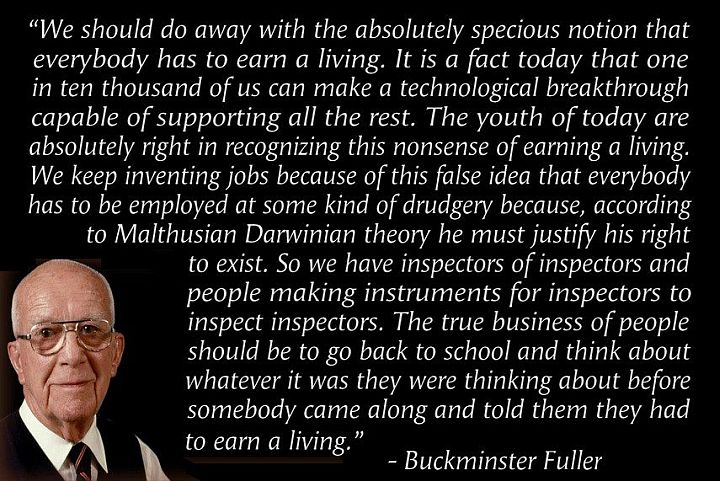
I wonder what the social implication will be when, over the next 20 years, whole sectors are automated. There are so many simple jobs that are /ripe/ for automation. If you're not doing the automation or some other high skill job, you're in serious trouble. Social welfare, and free money to the unemployed, are going to become an obligate, long-term realities.
> Social welfare, and free money to the unemployed, are going to become an obligate, long-term realities
Something tells me from watching what is going on in places like greece, spain, and even stateside in places like detroit and camden, that the above is not going to happen. Or should people expect central banks to print more and allocate more debt to people?
That might be because governments keep talking about going back to growth after the austerity measures. If there is no growth and unemployment stays at the current levels, things eventually need to change. And it's not only a governments' thing, with a large part of the population without any money, consumption will suffer a lot so companies will feel it deeply.
It's going to take some time though as nowadays the middle class doesn't like the idea of more social welfare since there's currently a direct connection to heavier taxes.
I think that the fruits of all these contemporary advancements won't be really seen until the global population starts dropping. Right now, automating generally puts someone out of a job and forces them into one that is more or less made up just so that they can have a job[1]. With a declining population, automation will pick up whatever slack worker 'scarcity' creates.
It's interesting to think about how that world would look like. Imagining a constant rate of production, this means that cheaper goods will be spread around fewer people. I imagine that this would drive a push away from mid-level jobs, probably into highly educated roles that innovate or maintain complex autonomous systems.
I tend to agree but if the consequence is less money for the companies to hire people then extending social welfare needs to cover for the lack of jobs available. I can imagine a lot of positive side effects if this happens.
Once again, we'll have large amounts of people in need of re education to learn new abilities for jobs that might not exist today. It's interesting as well what automation might do to economies with large work forces supported by governments.
Would be nice if the mining superprofits tax had gone through. Then at least we could be collecting some revenue from these vultures before they pick up shop and leave the place a completely uninhabitable toxic mess in 10 years' time.
No, not by very much. Computerised dispatching systems tell trucks where to go, even with human operators, and a human is probably a little better at driving than an automated truck. The gain is that the trucks no longer park for any reason other than maintenance, while humans have to stop to embark/disembark. And will frequently have, eg, a fatigue break during night shift.
If anything, supply/demand curve logic suggests there would be more trucks overall.
As you say, existing trucks are parked a bunch of hours a day. I think you and the parent have a semantic misunderstanding. You (i think) are saying there will be more trucks on the road, more routes being run at the same time. Th parent is saying fewer trucks will be built, because we can get 100% utilization as opposed to the 33% we have now. [1]
[1] disclaimer: i don't think robot trucks will have 100% utilization, and current utilization is probably higher than 1/3, i just guessed 8 hours of use a day. I think the point stands, more trucks on the road at the same time, but fewer trucks overall.
I understand what the parent is saying, I just disagree :).
My day job has large elements of mining haul truck performance. Currently most mines would probably be in the 40-70% utilisation band (for practical purposes), automating the trucks would probably add ... 5% utilisation? Maybe 10%? Both guesses, but they aren't likely to break 75% (I doubt they would break 65%, but I'm wiling to be surprised by evidence).
Practically speaking, the trucks would be more reliable due to automating, and in economic terms, truck hours/dollar would increase (*edit, said drop initially). Supply/demand theory tells us that mining companies could reasonably respond by buying more trucks.


Even the manned trucks have their routes all planned by computer. Some algorithm decides the most efficient way to move trucks around. Sometimes a driver will get a seemingly nonsensical instruction to deposit his load in a location other than the one closest to him, but when you query the computer about it, it's got a valid reason why that's a better idea for efficiency and it's always right.
The precision in the GPS trackers in phenomenal. Short range scanners pick up GPS tags on all corners of a bin, a robotic delivery system can place a gigantic item with mere centimetres of accuracy.
The human really is the weakest link in the entire system.
It's unsurprising the military want this. I remember being an outside contractor for PermoDrive in the early 2000s. They were just a small company from a small rural Australian town who developed a system which enabled trucks to store braking energy and later use it as forward momentum, reducing fuel costs by some large amount. Once they had a working prototype, the US military swooped in and bought the company.