> I am a pretty big RISC-V booster but RISC-V is going to cost way more for a while. It is simple economics of scale.
Yes. That's exactly my concern too. That can be expected to last until RISC-V application processors are a few magnitudes of order more popular. But it isn't as improbable as it sounds. Just a matter of time.
> But somebody designed the RISC-V chip and board you are buying and they will want to get paid.
Yes, that will be the licensing cost of the proprietary IP, excluding the hardware costs.
> RISC-V is inevitable. And the competition that will bring will pay dividends to all of us.
I hope so too. I'm just saying that it's too early to celebrate right now. It will probably take another half a decade as you mentioned.
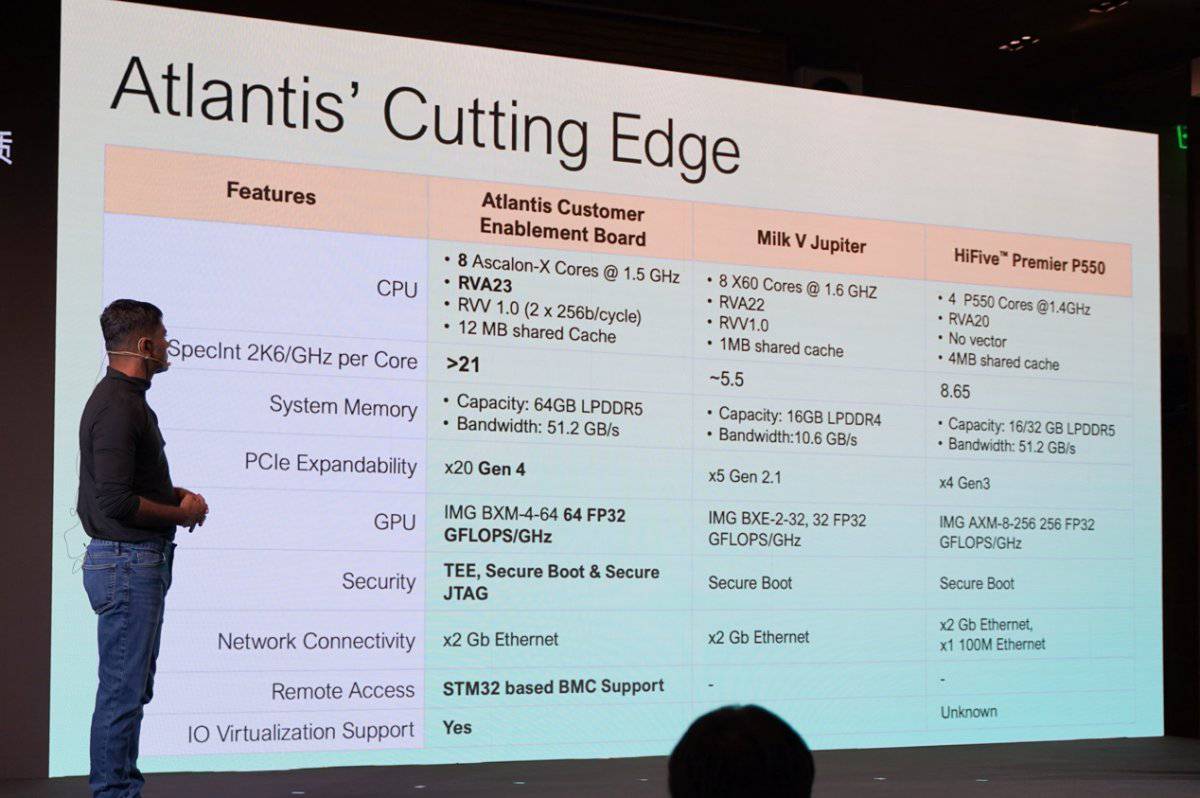
That should demonstrate sufficient performance for building products around it, and is ultimately one of many RVA23 options that will show up in chips this year.
It is not that I expect that Ascalon is going to be faster than Apple Silicon or cheaper than ARM. The price/performance is still likely to be such that these kinds of threads will be dominated with critics still saying that other options are better. Many will continue to wonder what the hype is about.
But what I fully expect and hope for is that Ascalon will put to rest the idea that RISC-V is some sort of toy platform or that it will be decades if ever before it can compete. Specifically, people will not be able to say that there are no RISC-V chips that can even compete with a Raspberry Pi 5.
After Ascalaon, it will not be fringe to propose that RISC-V makes sense for some use cases. Few will see RISC-V as a competitor to Intel, but many more will understand that RISC-V is a viable competitor to ARM.
And for us RISC-V supporters, Ascalon/Atlantis may be fast enough to actually use on the desktop. I have Intel based laptops that I still use daily that may not be any faster than Ascalon. That means that, for me at least, Ascalcon will already be fast enough. That is, if I will be able to afford it or even able to buy one. Fingers crossed.
I can dream of an Ascalon or Babylon based Framework mainboard.
Regardless, the rubicon will have been crossed. RISC-V will only get cheaper and faster after Ascalon. And, while x86-64 and ARM64 will too, there will be many, many RISC-V suppliers. There will be governments directly backing RISC-V research. The better RISC-V gets, the more players there will be and the more momentum the ecosystem will get.
My thesis is that it will be hard for ARM and Intel to stay ahead of all these other players. Certainly it will be hard to out-compete them all in every market. Which means that RISC-V will not only become viable but start to lead. And that is a radically different world than the one we live in now.
RISC-V is the hardware equivalent of the Linux kernel. And we know how that turned out.
Atlantis should come in with similar performance per clock to an Apple M1, but probably at around 2.5 GHz instead of 3.2 GHz.
That's close enough to be unnoticeable for most people for most uses, at least on the CPU side. It'll come down more to how well things such as GPUs and video CODECs are supported.
There are plenty of people using M1 or similar e.g. Zen 2 machines today with no inclination to upgrade. They are more than good enough.
It really doesn't matter much. The Titan and K3 are Core 2 performance, the K1 and JH7110 are more like Pentium III.
A 1.5 GHz Ascalon is still going to be ... I don't know ... Skylake level? More than enough for a usable modern desktop machine and a huge leap over even machines we'll start to have delivered 3 or 4 months from now.
Hopefully it will be affordable. As in Megrez or Titan prices, not Pioneer.
Single core performance is about what you say. But multi-core performance is much better. The K3 scores higher than a 2017 Macbook Air for multi-core on Geekbench 6.
And the K3 can take 32 GB of DDR5 and run a decent-sized LLM, which is not something you are doing on an a 5-10 year old laptop. In addition to the vector instructions, the built-in video codec acceleration and hypervisor stuff make for quite a modern feature-set.
The K3 is still too slow to be a desktop system for most people but there are some of us who would already be ok with it.
As for pricing, it is hard to find info. But it seems like around $200 may be possible for the Jupiter2.
Yes, I've been using a K3 for a few weeks now. It's quite pleasant, and if I use all 16 cores (8x X100 and 8x A100) then it builds a Linux kernel almost 3x faster than my one year old Milk-V Megrez and almost 5x faster than K1.
It's also great that it's now faster than a recent high end x86 with a lot of cores running QEMU.
Note that the all-cores K3 result is running a distccd on each cluster, which adds quite a bit of overhead compared to a simple `make` on local cores. All the same it shaves 2.5 minutes off. In theory, doing Amdahl calculation on the X100 and A100 times, it might be possible to get close to 11m50s with a more efficient means of using heterogenous cores, but distcc was easy to do.
RISC-V SBC single-core performance has been better than x86+QEMU since the VisionFive 2 (or HiFive Unmatched) but we didn't have enough cores unless you spent $2500 for a Pioneer.


Yes. That's exactly my concern too. That can be expected to last until RISC-V application processors are a few magnitudes of order more popular. But it isn't as improbable as it sounds. Just a matter of time.
> But somebody designed the RISC-V chip and board you are buying and they will want to get paid.
Yes, that will be the licensing cost of the proprietary IP, excluding the hardware costs.
> RISC-V is inevitable. And the competition that will bring will pay dividends to all of us.
I hope so too. I'm just saying that it's too early to celebrate right now. It will probably take another half a decade as you mentioned.