Those are not the same gasoline. Ethanol is high octane and so you mix it with a much worse grade of gasoline and get the same octane. E0 advocates attribute to lack of ethanol what is really just the better grade of gas.
That’s an issue if you’re running E100. Gas+ethanol blends will dramatically reduce ethanol’s hygroscopicity.
But if water is getting into your fuel (focus on fixing that, not your fuel choice), isn’t it better if the ethanol can carry it through the engine instead of just accumulating as a separate layer?
Nothing scientific but on motorcycle forums I used to frequent people often blamed E15 for seals swelling up and no longer working. I can’t say if that’s the cause but I did have a face gasket between the fill neck and tank expand. After sitting out for a few days it shrunk back to its original shape.
It's not like lead-free and eathanol-free gas is devoid of anti-knock agents... for much of those decades MTBE was used which was part of a groundwater contamination scandal.
Wikipedia has an interesting article on the subject @
Octane is a measure of the relatives ratios of the octane molecule with some other (I can never remember which). 100 octane means the fuel acts in your engine the same as fuel made from 100% octane molecule. 0 octane means it acts like 100% the other, 90 octane mean it acts like a mix of 90% octane and 10% the other.
You can go below 0 or above 100 if you find some other molecule/mix that acts worse/better, though how you extrapolate beyond the 0-100 range is subject to debate, confusion and deception. Ethanol is clearly better than pure octane, though how much depends on how you choose to extend the scale.
There’s also the issue of how/what exactly you’re measuring. There are two different scales that result in European readings being several points higher (eg US 93 is ~ Euro 98)
I find ethanol actually increases knocking in all of my engines. Switched to ethanol free years ago and I recall it made a difference in performance and mileage.
It will take time for the computer in the car to detect the ethanol and switch to a high ethanol fuel map. In the mean time, the engine is going to run pretty lean, since more ethanol is required than gasoline for the same volume of air. Running too lean usually causes the engine to buck and shake pretty badly.
This, of course, assumes that the car is even capable of running higher ethanol blends.
The performance benefits are mostly from turbocharged engines. Though, Chevy V8s can see solid torque gains over 4000 RPMs.
Once you get into the E50+ blends, you should have seen a huge mileage reduction. 10-20% for E50 and 25+% on E85. There's so much less energy density in ethanol.
Unless your car has a turbocharger or other means to run a higher compression ratio and thus take advantage of the higher octane of ethanol fuel. I've seen this done in lab and garage settings (they typically don't retain the ability to run regular gasoline), but I'm not aware of any commercially available engine that does. Race settings similar things as well, but they are trying to get power not fuel efficiency and so you can't get a fair fuel efficiency measure.
GM cars run separate tuning maps for E85 and E15 with an ethanol sensor to help the engine decide which to use.
You're not going to see the insane power gains possible on E85 from the factory though because the E85 map needs to be conservative enough to no blow up if someone suddenly fills up with regular.
> I'm not aware of any commercially available engine that does
Engines with knock sensors and advanced valve timing + phasing can do that. Source: mine does, stock '08 K20 engine, which has a very wide operational RPM range, so these things matter.
That's such a small difference it could literally just be that it's a slightly richer setting because E85 needs a higher fuel ratio for Stoichiometric burning.
Just like if you try run a gasoline engine on alcohol without adjusting the fueling it'll be too lean and knock if it runs at all, you'll be too lean with sufficient ethanol in the gasoline without adjustment.
But they're still higher octane fuels. E85 is specifically sought out for this purpose in the gearhead scene, so they can run high boost getting something alcohol-like at the pump.
Lots of anecdata of people running their regular vehicles on E85 without issues.
Lots of theoretical concerns “omg, you’re not following the owner’s manual, god is going to blow up your engine and kill 4 kittens”, but either nobody has blown an engine or hasn’t admitted to it.
Plenty of parts of the world where E85 is substantially cheaper than E10 (e.g. France where it’s ~43% cheaper) where I’m sure lots of people are running it or various mixes.


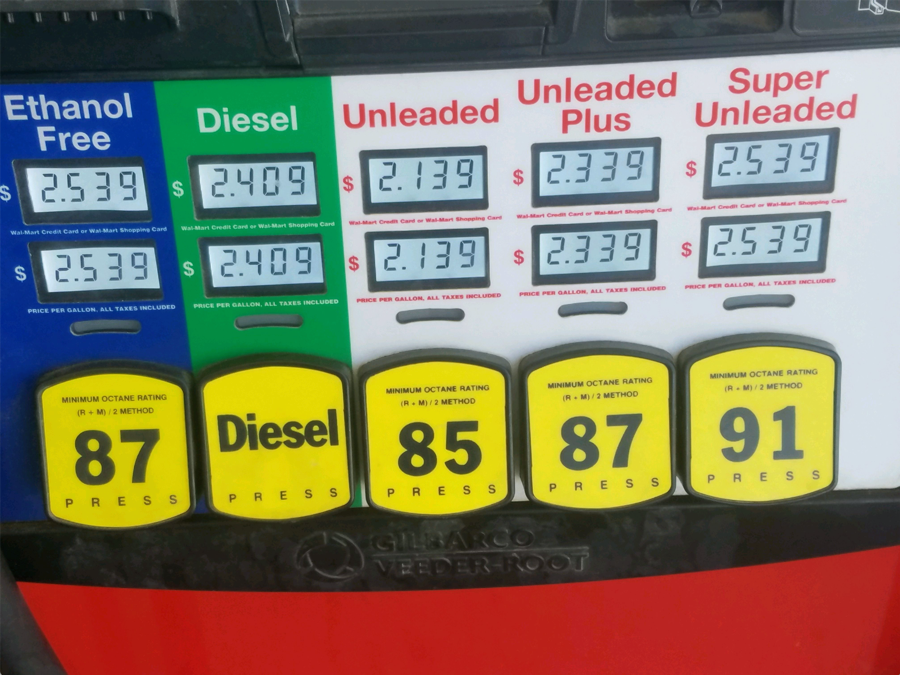
The past alternative was tetraethyllead, which had catastrophic environmental impact.
https://en.wikipedia.org/wiki/Tetraethyllead#Antiknock_agent