For people complaining about price, large eink panels are insanely expensive. The cheapest 13.3" panel with a min order of 1 is around $400-450. That's for a panel with no driver board. If you're interested in an easy diy approach, you can pick up a 10" panel with an arduino hat here for $200 [0]. Although if you step down to normal ereader sizes, you can easily pick up 6-7" panels for around $30 on aliexpress/ebay.
I mean sure if you don't mind the fact that ESLs tend to have horrible resolution. The chroma 74 you linked, for example, only displays 640x384 for a 7.4" panel. Good pick if they work for your application.
Depends on your viewing distance. If viewed from a few feet / a meter, that resolution is probably enough. The contrast ratio might be the bigger problem. From a low-effort search, photo paper has a contrast ratio of 100:1, while e-paper has a contrast ratio of only 12:1. Photos displayed on e-paper are going to look washed out.
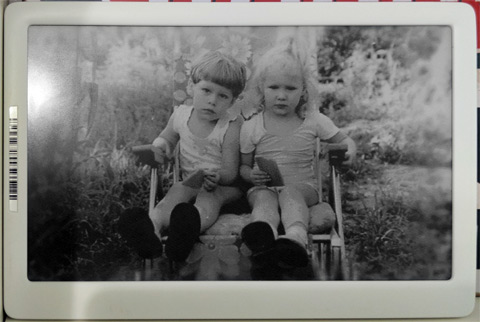
thanks to lack of very rough pixel boundaries, eInk looks quite goods even at that res, actually. Photos looks perfectly fine, eg: http://dmitry.gr/images/chromaGrey.jpg
If you want to hack it and don't want to pay for consumer grade quality for neither hardware nor software, then the device you linked is a good choice.
e-Ink price tags are designed to be used and abused by store public who do not care about store property. They are built like tanks, so "consumer-grade quality" would in fact be a downgrade...
I sure wonder for how much longer supplies are going to last. Those screens are from/were meant for the second generation Kindle (DX) that is over a decade old now.
Unfortunately there's no such offer on larger or color screens yet ... maybe one day.
That is surprisingly good contrast. Better than I've ever seen e-ink displays produce, and I have on occasion been looking - I'm a photographer and enjoy hanging my own work, and it would be convenient to do so this way.
On the other hand, for the same price as the 13.3" version and at the same size, I could print and frame approximately 80-100 photos, even from my gallery-quality inkjet - if I take the quality hit and use the HP AIO where the ink is free, that's about 200-250. (At that point it mainly depends on what kind of bulk rate I can get on the frames!)
So the unit economics don't really work out in favor of the ArtFrame here, I feel like. I wish they did!
As long as you have a good overall dynamic range. Granted I've only seen the same photos everyone else has, and not the panel in person, but if the photos are to be believed these panels have a better black than any I've seen before.
Very HN question, but are they hackable? I'd love one of these as a daily calendar; I've used an old/decrepit Kindle before for the same sort of thing, but something like this would be much more attractive.
I could assemble something myself, I guess, but I've got other projects taking up time and don't mind paying a little bit to turn the physical assembly problem (I'm bad at) into a mostly software problem (I'm mildly better at).
You can configure the device to connect to you local WiFi and fetch images from wherever. Sample code for an image server is available at https://github.com/framelabs-eu/imageserver
I love e-ink and these look really cool, but yeah, that price. Where are you currently getting your displays? You may be interested in EPDiy [0] (controlling cheap left over Kindle DX screens with an ESP32) and Inkplate [1] for some inspiration on cheaper sourcing.
For reference: the 6" Inkplate costs around 100€ and I think you could fairly comfortably build a 10" EPDiy device at around that. That's without all the fanciness of course, with it I reckon it should be possible to sell these things at around 200€ each, which would probably make them a lot more interesting to people.
That said: I'm excited for color e-ink screens appearing on the market. The amount of devices released lets me hope at least some will make it to a secondary market.
I actually have an Inkplate at home. The 8 gray shades they support are unfortunately not evenly distributed, which makes it difficult to display images in good quality.
You can't define more than 8. The API allows only 3 bit input. I also tinkered with the lookup table, and was able to create a lot of different gray shades, but I was not able to produce ~40-60% gray.
Just buy some very cheaply-available electronic price tags [1] and use open-source firmware[2] which supports greyscale + yellow. Save literally HUNDREDS of dollars/euros/etc. For extra credit, they are not only black and white eInk screens, they are BWY, so they can add a splash of yellow!
I would love a SIM variation of this -- where instead of uploading pictures via the frame's wifi hotspot, I could send the frame to grandparents and upload online and they'd get downloaded onto the frame via international SIM card.
Too expensive. Can probably buy several dozen nice color prints for that price and swap them manually. Sure you lose the tech / geek factor but for that eye-watering cost, I think it’s worth it.
The written sizes are correct. By default I will manufacture the two smaller displays with the same frame dimensions. The small device in the comparison image is from a custom order, which allows for a better size comparison. For custom orders I can create the frames in arbitrary sizes accurate to a millimeter. I'll add a note.
I made a photo frame for my mum out of my old iPad, just found a frame the right size and stuck it around the edge. So long as you keep it plugged in it works great. The family just adds images to a shared iCloud library and they appear on there automatically, in full color, and it cost me just the frame and not getting the pitiful recycling / resale fee for an old iPad.
What do you mean? What specific type of display, what size of display, what volume and what is the price? I keep hearing this claim about "insanely expensive" , "patent troll" and every time I've asked simple questions like which patent, what lawsuits, what prices, I've never gotten a satisfactory reply. Please have a look at my comment history, I believe the prices of electrophoretic displays are directly linked to their volumes. The displays in use in high volume products are cheap while those hand kerfed large panels are a couple of orders of magnitude higher cost since their volumes a couple of orders of magnitude lower.
I also already asked in that thread for any form of substantiation and never got a reply. It is weird to see that exact specific comment linked to again and again. Boing boing linked to that comment, multiple blog posts linked to that comment and used it as a citation claiming E Ink is evil. Well, I don't know if they are or not, but something more concrete than a throwaway comment and a self-referential insane infinite loop of comments would be necessary for me to form an opinion.
Mmmmm in comparison to normal displays they are really expensive, that’s pretty much all anyone is getting at. I can get a regular sized 1080p display for like $50, and the same size would be 10x for e-ink. The price is more for good reasons like you’ve explained, but still just high in comparison.
> The price is more for good reasons like you’ve explained, but still just high in comparison.
Yes, if you compare liquid crystal with volumes in millions of units per week with electrophoretic displays with volumes of at best a million units a month, then yes, it will be high. Even the difference in bulk materials cost alone will be 10x higher, not to mention the manufactured items like TFT backplane costs.
It always shocks me how much the cost of those panels holds adoption back. I’d love an A4 epaper reader, but I don’t want to pay what they cost at the moment.


[0] https://www.waveshare.com/product/displays/e-paper/epaper-1/...