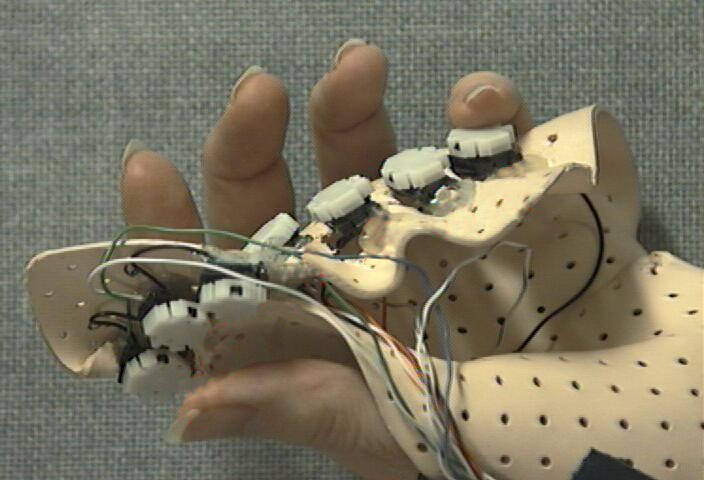
This is called a chorded keyboard [1]. Like seemingly everything invented in the following 40 years, it was introduced by Douglas Englebart in the Mother of all Demos in 1968.
Englebart had a iOS app that allowed you to chord type as well.
Douglas Englebart is the proof to me that even if you could go back in time, it isn't necessarily true that you could leverage your knowledge of future technology. Poor guy messed up the timeline so much that even his stock market knowledge was useless!
Englebart famously demoed possible ways of interacting with computers that are now ubiquitous decades before they were actually popularized. I made a joke about him only having those ideas because he was a time traveler from the future, but tried to implement them too early. Then, after he already didn't make billions from his ideas, he couldn't use his future knowledge of investment because his demo was still big enough to change which companies got wealthy (explaining why he didn't make billions investing in the companies that actually invented those ideas in his timeline).
I'm sure I remember an Asimov story where a reporter is hiding one of these in his pocket and taking notes unobtrusively, hoping nobody will notice the small hand movements.
I used a nice IBM chord keyboard in the late 70s but can't find a photo. It had the space bar sticking out to the side for your thumb; the other keys didn't just have a divot on their tops, as with a typical keyboard today but also on the faces and corners to encourage you to press multiples. With some practice you could get pretty fast.
I thought it would be cool if I could base a chorded typing system off an actual digital piano and use the MIDI interface to type, and design it such that most words would actually sound nice if the digital piano outputted sound at the same time. I just haven't put in the time to figure out a good efficient system.
Would be kind of neat if I could "hear" a blog post as I was typing it, and maybe eventually even learn to listen to text transcribed as music.
Part of what makes music so wonderful (and universal) is that it encodes information somewhat more ambiguously than written or spoken language. You could probably see comprehension and memory dividends from transitioning to a music-based communication system - especially considering that we're hardwired to process music even more so than we are to process language - but I dunno if I'd want to give up the aforementioned aspects of the human experience.


Englebart had a iOS app that allowed you to chord type as well.
1. https://en.wikipedia.org/wiki/Chorded_keyboard