This is not "bankruptcy protection". The WSJ writer is thinking of the US's lenient Chapter 11 bankruptcy procedures. Hanjin is going into receivership, with a court in charge. Ships and loaded containers are stranded all over the world.[1] Two Hanjin ships are anchored off Los Angeles, unable to unload because there's no one to pay the port fees. Railroads and ports are sending unshippable containers back to the shipper.
This isn't a big deal for trade generally, because there's huge overcapacity in shipping right now. Hanjin is only 7% of Korea's export shipping. But it's a huge deal for businesses with product stuck on Hanjin ships.[2] It's also a big deal as US retailers stock up for the Xmas shopping season. Spot container shipping prices just shot up. That won't last, but it may last through the Xmas runup.
The court in Korea will probably authorize funds to get the ships unloaded and get them to some storage location, but it's not clear when. That's the biggest headache. The shutdown is not being handled well.
Historically, big firms in Korea were protected by the government, and bailouts were common. That's declined, and attempts to put together some kind of rescue deal for Hanjin have already failed. There's no big reason to rescue Hanjin; Korea alone has excess shipping capacity.
Hanjin has obtained an injunction in Korea against seizure of its assets, says Lloyds List.[1] Right now, Hanjin ships have been ordered to stay offshore to prevent seizure for unpaid claims until the legal situation stabilizes. It looks like Hanjin is going to file for Chapter 15 bankruptcy in the US, which means US creditors get Chapter 11-like treatment: old claims are stalled and new bills can be paid. Claims have to be resolved in the primary bankruptcy court in Korea. Then the ships may be able to unload and head back to Korea, pending further court action to unwind Hanjin.
BIFA info on What to Do if Your Container is Stuck on Hanjin: [2]
Big mess for shippers. Especially Samsung, which used Hanjin heavily.
Any insight into how this happened so suddenly? Somehow they managed to pay for fuel and crew to get across the ocean, but didn't have money to pay the stevedores?
How does that happen? Couldn't one of their executives whip out a credit card for the labor? It seems dangerous to have something the size of a container ship sitting around near a busy port.
Ha that's great. It reminds me of the Wizard of New Zealand.[1]
> In 1982 the New Zealand Art Gallery Directors Association issued a statement that in their opinion the Wizard was an authentic living work of art and the City Council appointed him Wizard of Christchurch. In 1990 the Prime Minister of New Zealand, Mike Moore, an old friend, appointed him the official Wizard of New Zealand.
There is a strong tradition of state intervention when bankruptcy in container shipping is likely. Both German and French lines have been saved by their respective governments.
No. RoK chief financial regulator: “The government will let the company resolve its liquidity crisis on its own and handle the issue in accordance with ‘principles’ in case of failure.”
There have been negotiations underway for months. They broke down on August 30 because the parent Hanjin Group and key family members didn't want to put in enough of their own money, for fear of bringing down the entire group. If the parent wouldn't put in more money, neither would the banks or creditors.
Best overview of the resulting mess, from the BBC: [1] There are 540,000 containers stuck in transit. Hanjin runs some port facilities; those are shut down. Nobody is paying the seafarers stuck on ships. Empty Hanjin containers are piling up and Hanjin facilities aren't taking them back. (You pay $50-$100 a day until you return an empty.) The association of big US retailers is trying to get the US government to get the Korean government to do something to get things unstuck.
It's not clear what this means for Total Terminals Inc, which runs the biggest terminal in Los Angeles and another one in Seattle. TTI is a subsidiary of Hanjin Shipping Holdings Co. Ltd.
The last time a big shipping line went bust, it took six months to clear the backlog.
Hanjin's own web site still has no indication anything is wrong. They don't seem to have prepared for a shutdown. It looks like management assumed that somebody would step in and save the company. That didn't happen.
>The last time a big shipping line went bust, it took six months to clear the backlog.
So I don't know a lot about accounting, but it sounds like the total costs of this backlog are likely to be far greater than the port fees?
If so, it seems like it would make sense for insurance to be structured such that it pays these fees now rather than having to pay out all the claims for late delivery later?
I suspect they already are, just not on behalf of Hanjin.. Quoting:
"The Korean government said it wants Hanjin’s domestic rival, Hyundai Merchant Marine Co. , to buy healthy assets from the troubled company. It rejected the idea of a merger."
Translation: SK is going to shoot Hanjin in order to prop up Hyundai. I suspect as part of any "deal", Hanjin is going to wind up saddled with a bunch of bad contracts from Hyundai, too ...
That would be a smart move, at least politically if not economically.
People have been wary of large bailouts since 2008. The Chaebol family that owns Hanjin is especially unpopular in Korea, due to a widely publicized incident where one of their daughters threw a tantrum on board an international flight and made it return to the gate.
The President of South Korea cannot afford to make any move that would hurt her (already rather low) popularity rating. She needs to throw Hanjin under the bus if she wants her party to have a chance in next year's election.
Besides, the government is too busy trying to rescue the shipbuilding industry, which is worth much more to the Korean economy, to babysit a shipping company.
That will not be as easy as it may sound. The court (the appointed receivership) is obligated to ensure the best possible price for the assets, so Hyundai is likely to have to bid for the vessels in competition with other actors. What the government might do (a model used in the past) is to offer Hyundai support (guarantees) for the financing of the purchase, which might enable them to enter a winning bid at a de facto lower cost than the competition.
Update for today: big mess continues. Four Hanjin ships now off the coast of California. They can't enter US waters without being seized.[1] Almost all of their ships are at sea or at anchor, although a few in China were seized. Lots of lawsuits filed. Hanjin hasn't been paying its bills since June, which is why there are claims against their ships.
Freight forwarders (like Flexport) face big financial problems. They may have paid Hanjin already, but still have the responsibility of getting the containers to their destination at their expense. Maritime insurance won't pay for this; it's a financial problem, not an accident. Lloyds List quotes a freight forwarder in Australia: “There are bound (to) be freight forwarders with cargo on these vessels. F+++. I haven’t had one (of) these since the Nigerian crisis 40 years ago. F+++.”"
It's not clear if ship crews will ever be paid. There's concern about ships running out of food and fuel.
The bankruptcy court in Seoul has given Hanjin until November 25th to come up with a plan. Hanjin web site still says absolutely nothing about problems.
The article was a bit scarce in some details, can anyone fill in? Is hanjin doing 25k teu, or 50k (of double size)? What fraction of Pacific shipping is that?
7% of US trade, but is it hitting intra Asia trade worse?
It says Hanjin has 2.9% of the world market share for container shipping, but among Korean exporters, it's a lot more. For example, Hanjin handles 40% of Samsung's exports and 20% of LG's. Still they're fairly small compared to Maersk, which has 15% market share.
Wow, Does anyone know what this means for the dry baltic index. A bunch of shipping companies look like they are pretty close themselves to bankruptcy.
Probably having a really bad day. Flexport: "Our logistics managers and licensed customs brokers work around the clock to make sure that your shipments move smoothly." It's their job to deal with the problems created by Hanjin for Flexport customers. The terms and conditions for international freight forwarding are standardized [1], and while some events (wind, wave, war, etc.) let them off the hook, bankruptcy of their subcontractor is their problem.
To get economies of scale, you want big container vessels. Customers usually want a weekly vessel call to their port. It's impossible to fill the bigger container vessels on your own. Therefore there are various alliances, whereby multiple shipping companies combine their vessels and share their capacity. The amount of containers you can put on a vessel is then determined by how much of the capacity you bring in. Simple example: for a service with 7x 10.0000 TEU vessels, if Hanjin owns/supplies two of those 10.0000 TEU vessels, it'll 28.6% of the capacity on each of the 7 vessels. Then you have another benefit that by loading ("stowage") efficiently you might be able to fit more containers than usual.
Hanjin is part of the CKYHE shipping alliance. As such, on various (not all!) Hanjin vessels there's not just containers booked with Hanjin, but also from the other shipping companies. According to http://www.hellenicshippingnews.com/ckyhe-alliance-cooperati...: "CKYHE alliance members Cosco and Evergeen are set to move to the new Ocean Alliance with CMA CGM and Orient Overseas Container Line (OOCL) in April next year leaving just K-Line, Yang Ming Line and the financially struggling Hanjin Shipping."
After the financial crisis, it became really cheap to lend money. Various banks noticed that a slight profit was being made in shipping. As a result many new big container ships were built, mainly due to bad decisions within banks. There's now (again) a huge oversupply of capacity vs demand. This has a drastic effect on freight rates. E.g. http://www.wsj.com/articles/maersk-profit-drops-on-weak-frei... has this bit: "Maersk said average container freight rates for the second quarter were off 24% from a year earlier, while the oil price was down 26%."
Container shipping companies are often bailed out by countries. E.g. AlphaLiner had a bit (weekly newsletter, don't have a link) where COSCO got huge amount of money (IIRC 200 MUSD) from the Chinese government in 2015 to scrap vessels. This is the only reason they had a tiny profit in 2015. In 2016 the freight rates are drastically lower! Any company will need to do a crazy amount of cost saving, even though a lot of the costs have already been invested (if you bought containers & container vessels they're not suddenly become cheaper to run or to write-off). COSTCO lost 1.1 billion in the first 6 months of 2016 (http://www.chinadaily.com.cn/business/2016-08/27/content_266...), though they're likely also affected because they recently merged with another shipping company. Way more capacity than demand. In news articles this is often misinterpreted.
Future: If Hanjin goes bankrupt, their container vessels will still exist. These vessels will likely being purchased at a much lower price. To fill them, anyone purchasing these vessels will likely take advantage of the lower purchase price and offer even lower freight rates. I don't expect the supply and demand to change quickly.
>To fill them, anyone purchasing these vessels will likely take advantage of the lower purchase price and offer even lower freight rates. I don't expect the supply and demand to change quickly.
The supply of shipping hasn't changed (still the same number of ships, just different owners), and the demand of shipping hasn't changed, so wouldn't the cost of shipping stay the same?
There's no incentive for the new owners to lower their prices just because they got their hands on some cheap ships. They would probably rather just make a higher profit instead.
Within any shipping company you usually have various container vessels which you own, then various that you charter. This allows you to be flexible. So a shipping company could hand back some chartered vessels, then buy Hanjin ones. If they buy it cheaply, the average cost per day should be lower than the charter rate.
Ideally they'd do this in a smart way. So same size vessels and just reduce cost. In practice, they'll probably buy bigger vessels than they used to have (bigger vessel has a lower cost per container, provided they're fully utilized). Then lower the rates as they notice it is difficult to fill them (no change supply/demand).
A few years ago the shipping companies idled vessels to reduce capacity (instead of lowering prices). In 2016 it seems they do both (bit of idling, but also compete on price).
There's no obligation to reduce costs, but there might be the opportunity to do so.
If Hanjin's ships go at fire-sale prices (no idea), and if financing costs are a major component of operating costs (no idea), then you raise the possibility of a carrier with a reduced set of operating costs (lower debt obligations) competing in what's already a very soft shipping market (I've just posted HARPEX, the freight shipping index analog of BDI, and that it happens is pretty poor).
In a market where capturing more marketshare means higher net cash and profit, there's a benefit to underbidding competitors. If you can strategically underbid another low-margin, high-cost shipping company, and/or crowd in specifically on their markets, you could capture yet more of the market.
This isn't entirely unlike the game J.D. Rockefeller played in consolidating the oil extraction and refining business in the 1870s and 1880s, with significant collusion via railroads, to whom his Standard Oil was often a largest single customer.
The question is whether you're playing the game for profit or power.


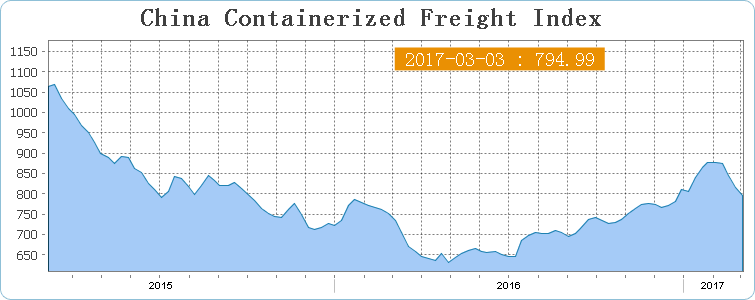
This isn't a big deal for trade generally, because there's huge overcapacity in shipping right now. Hanjin is only 7% of Korea's export shipping. But it's a huge deal for businesses with product stuck on Hanjin ships.[2] It's also a big deal as US retailers stock up for the Xmas shopping season. Spot container shipping prices just shot up. That won't last, but it may last through the Xmas runup.
The court in Korea will probably authorize funds to get the ships unloaded and get them to some storage location, but it's not clear when. That's the biggest headache. The shutdown is not being handled well.
Historically, big firms in Korea were protected by the government, and bailouts were common. That's declined, and attempts to put together some kind of rescue deal for Hanjin have already failed. There's no big reason to rescue Hanjin; Korea alone has excess shipping capacity.
[1] http://www.seatrade-maritime.com/news/americas/hanjin-shippi... [2] https://theloadstar.co.uk/forwarders-dangerously-exposed-by-...