If Linux had a revenue stream and model, this would make sense. But the style of open-source is to make good software, and let others gravitate to you as a result.
I did something similar, but with GitHub Discussions because my blog is hosted on GitHub Pages and composited with Hugo, and I wanted all components to run as close as possible to one another: https://jasoneckert.github.io/myblog/github-discussions-blog...
I don't think that's inconsistent - all but one member of NATO share the same values currently, and it's important they work together to resolve the current annexation threats from the US. That particular sign can be taken off later, if necessary.
When it comes to laptops, I’ve primarily used MacBooks but really miss the excellent keyboard and TrackPoint on ThinkPads. Nothing seems to comes close.
My solution was to buy a Lenovo ThinkPad TrackPoint Keyboard II and pair it with my MacBook over Bluetooth. An added benefit is that I can keep the MacBook on a stand, avoiding the wobble you get when typing directly on it.
I also use an Apple Trackpad alongside this setup, since I find it hard to beat for certain tasks.
The most important benefits in my opinion are choice and price - people like me who prefer to buy software outright can still do so at a reasonable cost, while others who opt for a subscription can also do so (again, at a reasonable cost).
It's pretty clever that they keep the "pay one time" option still alive while announcing the availability of subscription, so anyone who says "Boo, not you too Apple" can easily be shut down with "You still have the option to buy it!" instead of leaving those critics without answers. Of course, they'll eventually remove the option to buy the software by paying once, I think everyone can see the writing on the wall, but still clever of them to choose to do it later for PR purposes. 1-0 to Apple :)
Final Cut Pro X has been available for purchase (at the same price, IIRC) for well over a decade now. Pro feathers were ruffled at the time they leapt from FCP7 to FCPX: the $299 price point was something like 1/4 of the going rate for its predecessors, was Apple planning to abandon its pros for the consumer market? Well. Here we are almost 15 years later, and if you paid the one-time price back then, you're still getting free updates today (at least on desktop). And you can still buy in with 299 2025 dollars, rather than 299 2011 dollars.
At the time, the common wisdom was that they'd go the same route as Adobe: you'd have to buy Final Cut X+1 in a couple years for another $299, and Final Cut X+2 a couple years after that... to their credit, that's not the way it's gone.
So that way, I imagine, all the film folks have a little more money to chuck at their high-powered Mac hardware budgets in the next refresh cycle instead... An evergreen Final Cut Pro license costs almost as much as 1TB of SSD from those guys!
That is true, but it is also true that FinalCut lost big time against DaVinci for all semi-professional users which are exactly FinalCut's main target group.
I'd argue that it is very likely that Final Cut X+1 was Apple's plan. It just did not pan out and they were busy with other things. Now they made the first step correcting that (or cutting the losses, depending how you want to see it).
Davinci Resolve is free. At least, for the non studio version. (There’s a few studio only features, but almost everything is available in the free version of resolve). And a lot of people want to learn resolve anyway for color grading. Why not just edit in resolve too? Resolve studio is also quite cheap, given you buy it once and own it forever. Including updates.
I spent last week helping out at a short filmmaking course. The DP running it has used Final Cut for his entire career. But not a single student chose to edit their film using Final Cut. The class was split between resolve and premier pro. (Premier was chosen by a lot of people because it’s what they use at school, and they have a free licence to premier from their school while they’re studying.)
+ purchasing any BMD camera and you usually get a "free" license of DaVinci :) That's how I got my license many moons ago.
Now BMD have "prosumer" cameras available too that doesn't cost half a liver, which the second-hand market seems flush with too, so you can grab really good hardware for "cheap", and get excellent software with it too as the license is movable across hosts :)
> At the time, the common wisdom was that they'd go the same route as Adobe: you'd have to buy Final Cut X+1 in a couple years for another $299, and Final Cut X+2 a couple years after that... to their credit, that's not the way it's gone.
And that's despite Apple having zero interest in doing things that don't ultimately make them money.
I have a theory for how sales of these one-time-purchase yet indefinitely-updated apps happens to work out positively on Apple's balance sheet, while it doesn't for most other large players right now.
And that's that, due to Apple's vertical integration (they make the hardware, they make the OS that runs on the hardware, they make the apps that run on the OS) — and due to these apps only targeting their own OSes+hardware, with no consideration of portability to other platforms — a lot (like 90+%) of the "enablement" work for these apps ends up time-budgeted as OS work, rather than apps work.
Or, I guess, to be more charitable, you could say that Apple's engineers develop first-party apps not just to sell them, but at least in part to drive the development of the OS as a developer platform. You could even describe the OS frameworks as the product, and the apps themselves as the byproduct. (In that lens, the only reason FCP would cost anything at all is to avoid accusations of anti-competitive behavior.)
The core of Apple's success has always been to capture the cultural leaders. Artists, musicians, journalists, etc. have used Apple at much higher percentages than the general public.
Now that the iPhone made Apple much more of mainstream company, it's harder to do -- what does it mean to focus on cultural leaders when 90% of American teens have an iPhone? But in the 15 years since Steve Jobs' death they have still been doing a decent job of it.
One beancounter way that I think has been used to justify the strategy - FCX and the like are currently also sold as paid upgrades at time of machine purchase. This is another way to bump up the average price of the computers outside BTO.
It also frames the cost of the software differently, as part of a much larger purchase and as enabling other uses for the new machine. I suspect this is a fairly large sales channel for the software.
That makes me wonder how this new suite strategy (as well as other subscription efforts like AppleCare One) play into the purchase experience going forward.
The one-time purchase version of Microsoft Office is not available worldwide. Where offered, it is reduced to Word, Excel, PowerPoint, and OneNote, with Outlook as a Business edition extra. Individual apps can sometimes be bought separately, but pricing usually makes this impractical. This is to push buyers to Microsoft 365 subscriptions which is the primary product.
Microsoft is renaming the company to copilot, all of its software to copilot, and CEO satya nadella is changing his name to copilot copilot copilot which is also his favourite feature, software, operating system, and the names of his dog, cat, children, and spouse.
Soon the company formerly known as Microsoft will turn into a garbage slop Pokémon capable of emoting only with its name, copilot.
Yes - but perpetual purchases have an interesting gotcha that Microsoft didn't realise at first. To encourage subscription over perpetual, ongoing or evergreen updates are limited to subscription version.
Office 2024 has every feature that was added since Office 2021 to the subscription version - while a chunk of loyal customers are unaware of them.
Back when Google was competing hard with Google Suite, a big perception problem formed with the perpetual customers believing and convincing others that Google were far ahead, with collab editing and other features - after Office had added equivalent.
So for me, If there's a subscription and one-time option - I wonder if the one-time gets all updates going forward. If it doesn't, I realise that they'll regret that if competition picks up, and try to fix it later.
If it does include updates... I worry it will be like many other lifetime updates one-time purchases - when competition is low they'll renege on that promise.
You would definitely not get free upgrades for Office. You would get minor point release updates. You also had to upgrade the Mac version often for:
- the System 7 transition
- the 040 Macs and to get a “32 bit clean version”
- to get the full speed of running natively on PPC Macs
- to get a native OS X version instead of one that ran in the OS 9 sandbox
- the Intel transition to get native performance.
I would much rather pay $150 (?) a year for a five user license where each user gets 1TB of storage and each user can use Office across Macs, Windows, iPhones and iPads.
It’s the same price as Dropbox’s 2TB plan and all you get for that is storage.
On a related note: Steve Jobs was right - Dropbox is a feature not a product.
Yes. That sentence is setup for the speculation in the third paragraph. Folks in this sub-thread are wondering how the one-time price option plays out with Apple Creator Studio.
If you look at Office 365, OneDrive, Teams, SharePoint and Exchange Online as well as AI services and coauthoring are not included in the one time purchase price, as these require ongoing infrastructure supplied by Microsoft.
If you look at Adobe Creative Cloud, you see cloud storage and cloud libraries for maintaining files and assets and sharing them for collaboration, Behance, asset licensing such as Adobe Fonts, and generative AI tooling, as well as a pile of additional apps which were never sold separately. There's also tutorials to help you learn that smattering of apps and plugins.
Apple Creator Studio is a service, so there will likely be at least some product development going to create exclusive functionality - likely in the form of new apps which cannot be bought separately, content packs, AI integrations, additional collaboration features relying on hosted infrastructure, and so on. Since a lot of the storage features and base collaboration are instead part of the iCloud infrastructure, that last point may be a tricky line to walk though.
So far from what I can tell, Final Cut Pro has gotten perpetual updates. Since you can only buy it via the Mac App Store, ther can’t do upgrade pricing.
They could - and some of the 3rd party vendors did: There is a 1Password 7 and a 1Password 8. There was also a Things 1/2, which is now a Things 3. it usually works by creating a new app, and not updating the old one anymore.
Because there is no such product as Office 2025, much like there was no Windows 96. There is Office 2004, 2008, 2011, 2016, 2019, 2021 and 2024. They usually release roughly every three years so there might be an Office 2027. 365 is a separate (but closely related) product.
> Of course, they'll eventually remove the option to buy the software by paying once, I think everyone can see the writing on the wall
There's no indication Apple is planning to end the option of paying once for these apps.
Apple introduced subscriptions for Final Cut and Logic nearly three years ago [1]; this isn't new by any means. Pages, Numbers and Keynote remain available at no cost.
Why do you think they will remove the option to buy the software?
They’ve kept the model for years. They’re targeting different audiences with the move.
There are features they are planning to make exclusive to the subscriptions. I don’t know if they’re planning to make the one-time purchase go away completely, but it seems like it’s going to be approached as the “lesser” option.
> so anyone who says "Boo, not you too Apple" can easily be shut down with "You still have the option to buy it!" instead of leaving those critics without answers
This is like saying that it's clever for Mars to keep Mars Bars while launching a new bar, as it "shuts down" complaints that Mars Bars will no longer exist.
I don’t really understand the point you’re trying to get at but your analogy doesn’t really work here because a new chocolate bar would be a new product. Not a different way of buying the same product.
Every choice a company does is a strategy in some way, for some reason, which has been calculated to make them more money than another choice. This is how 99% of businesses work, and Apple as well.
You have any email I could reach out to you on once Apple finally removes the purchase ability for this, and only lets people subscribe?
> You have any email I could reach out to you on once Apple finally removes the purchase ability for this, and only lets people subscribe?
If they do this, then still no one will ever have to say something as silly as "they only kept the other option so people won't complain about them removing the other option".
Not Apple, but iMazing switched to subscription model and they simply lost me as a customer.
JetBrains tried something similar a while ago too, and almost screwed it up - but managed to listen to their customers and nailed it with the perpetual fallback licensing. Making me not just pay the subscription but feel respect to the company.
The other thing that’s going to go away is purchasing only what you need. I want exactly one of these apps, I bet virtually nobody uses all of them, and yet the suckers are going to be telling us that being made to buy stuff we don’t want or use is “more value”.
Of course predictions about the future are not present reality.
It’s not set in stone, but it’s supported by the times this has happened before and by trends in Apple and in tech. “Nothing will ever change” is a prediction, too, and one much less supported by evidence.
I think it's okay, or even better probably, if they move to subscription only. All Apple's paid apps have languished for years and if its actually a revenue stream for them maybe they'll actually make them industry-leading again.
This is such a strange way to think about what was done. Rather than just being happy they kept the pay once option and saying that's good you're imagining critics who how Apple can "shut them down."
Yea I've already purchased some of these apps so I was not going to thrilled if they pulled an Adobe and made me pay for an overpriced subscription on top of it >:(
Exactly what I was thinking. I bought Pixelmator Pro 3 days ago… But I am happy, as I have absolutely no need for the others, except for the free ones.
It's not outrageous, for sure, specially if you happen to have a use case for all the bundled apps. But things change if you consider that the one time payment for Logic Pro equals about 18 months of the subscription. In my case, I bought Logic Pro in 2013 for 180€. Obviously a subscription seems expensive no matter what the price is.
If a students needs Logic Pro for 3 months for a class then they can get it (with the other apps) for $9 total ($6 if you count the free month). That makes more sense than a one time fee of $200. On the other hand, if you're planning to use the software for over a decade like yourself then $200 is very cheap.
Indeed, and considering the 14 years of free Logic upgrades I'm surprised they bothered charging the initial $199! (I do remember being a bit miffed that it was $199 regardless of my existing license for the giant $999 box that was Logic Studio.)
> It's pretty clever that they keep the "pay one time" option still alive while announcing the availability of subscription, so anyone who says "Boo, not you too Apple" can easily be shut down with "You still have the option to buy it!"
Probably not. Those customers are almost completely irrelevant and not people who Apple or anybody else cares about. They won't mind if you kick and scream.
Yes, of course, ultimately every choice they ever do is for money, because they're a for-profit company. But maybe we can be slightly more granular about exactly how that choice makes them more money, which is because it gives them good PR. I was just being more specific, but we're saying the same thing :)
Parent isn’t insinuating otherwise. They’re saying the subscription model is more lucrative, so eventually they’ll remove the one time payment option, but keeping it as an option for the announcement keeps the bad PR at bay.
So what about next year when all of the apps receive updates/upgrades? Will the paid-in-full versions receive the upgrade for free, or will they have upgrade prices? I remember the days of Adobe's annual version upgrades, and they were at least $99 per app. Using that as the basis, the Adobe subscription plan is not more expensive that just broken up into 12 payments. People that kept running v4 to avoid the upgrade prices eventually got left out as they could not open files provided to them from others using the most recent version. Let's not forget our history on the one-time purchase pros/cons
These are being sold on Apple's AppStore, and there the model is that you get all of the updates for that App. Of course there is the work-around that some apps use, which is to create a new App (i.e.: MyApp vs MyApp2), which Apple could do at some point in the future.
The best one to watch at the moment is if Pixelmater Pro license holders from before it was bought by Apple get access to any of the new improvements.
All companies should do this. Sometimes I want a one-time purchase. Sometimes I want to try the program for a few months and I prefer a cheap subscription over a big upfront cost. And very, very rarely, I'll prefer the subscription, even though it's more expensive over time, to support a cool indie studio with recurring revenue instead of one-time purchases that may dry up and lead to lack of interest from the devs.
This is my argument for the Adobe subscription. One day, I'm a photographer needing apps like Photoshop and Lightroom and After Effects (because I do a lot of timelapse). One day, I'm a graphic designer, so I need Photoshop and Illustrator. One day, I'm an editor, so Photoshop, Premiere, Illustrator, and After Effects. One day, I'm doing desktop publishing with Photoshop, Illustrator, InDesign.
The smooth, tile-based interface of Metro/Modern UI of Windows 8 and the Windows Phone are underrated in my opinion. It was simple, fast, and focused on touch. While I didn't have a touch-based Windows 8 laptop or tablet at the time, I had a Windows Phone, and I enjoyed using it more than any other device I've had since.
> The ... UI of Windows 8 and the Windows Phone... underrated in my opinion. It was ... focused on touch.
That's why it was rated low. Most people were using this interface on PC's and laptops, without a touchscreen, where a touch-focused interface does not make sense. Maybe it was good choice for Windows Phone or Windows Tablet, but people were not rating it based on that experience. The very idea of using a single UI for both a touchscreen-oriented and no-touchscreen, kbd-and-mouse computers is the most problematic aspect of it.
> It was simple
No, it wasn't simple. There was the simple part, but things not integrated into the simple part were a hodge-podge of previous Windows versions' UI. Now, I like some of the previous Windows versions' UI, but putting a simple veneer on something does not make it simple; if anything, a little more complex.
> It was fast
The fact that an OS UI in the 2010s or 2020s need to be commended for being fast is kind of sad. Plus - I don't believe it was that fast. Did you try running it on, say, a 15yro machine relative to the Win8 launch time? i.e. 1998? Even with a 10yro machine I believe it was kind of sluggish.
It was amazing. Ran circles around Android on weaker hardware, but because duopoly duo didn’t want to accept competitor it was artificially hamstrung and subsequently killed.
No, the death of Windows Phone was 95% the fault of MS/Nokia.
Pre-announcing that they were leaving all Winphone 7 customers behind for Winphone 8 meant that every retailer/distributor was left with unsellable stock (because they hadn't gained enough traction to sell out initial shipments).
If this was because Nokia made bad/cheap phones that were un-upgradeable or MS being arrogant isn't something I'm remembering anymore but the end-result was pissed retailers and nobody selling WP8.
The spec for wp8 was a lot higher than wp7. There was a bit change from WinCE kernel to WinNT kernel, etc. Without much confidence, I think wp8 was dual core or higher and wp7 was single core... and maybe there was a ram upgrade too.
All that said, WP8 did a lot better than WM10, where the WP8 phones were promised to be upgradable, and then the promise was walked back for low mem phones, and the experience was poor for qualifying phones anyway.
The final build of WM10 was actually ok on my Lumia 640; but that was way after everything was canceled and mobile Edge (this was the first non Chrome Edge) was still less usable than mobile IE, even though the renderer was better.
The really poor rollout of wm10, plus the tradition of forcing developers to make split builds to support multiple versions of windows phone/mobile made things pretty bad at the end. Calling the build for WM10 only 'universal' was icing on the cake. Android has all sorts of problems, but you can have a single APK that works on lots of versions, with some amount of new features get pushed to old OS with libraries and some new features have to be detected at runtime and use alternate flows. On the other hand, Microsoft kept making new features require using new foundation libraries that were unavailable on old phones. WinCE -> WP7 -> WP8 -> WP8.1 -> WM10 was too many step changes and developers bailed at each one. Meanwhile on the desktop, a 32-bit win32s application targeting windows 3.1 has a good chance of running on windows 11.
Also, they managed to make upgrade from wp8 to wm10 break installed apps sometimes. That wasn't great.
On Android, if you try to make an APK that is compatible with both old versions and new versions of Android, you get a ton of scary warnings when you attempt to install it.
That was the final nail in the coffin. The reason why they didn't hit adoption in the first place is because Google prohibited their application on MS devices. Mobile YouTube already wasn't good enough, and without the rest of the GSuite (Maps, Gmail, Chrome, Calendar, Translate) it was dead in the water. And no, HERE maps and third-party clients were not good enough to tip the scale.
This wasn't (only) about Google refusing to make apps for the WP, it was Google actively preventing WP apps from accessing their services where they could. Microsoft made a very nice YouTube client, for example, and Google simply denied YT access if they detected you were using it.
Retailers couldn't sell what the carriers didn't want on their networks. The carriers had momentum from consumer demand to keep selling iPhones. The carriers were given a lot of the "keys to the car" by Android and carriers were really happy with the ability to modify Android and/or micro-manage it, so they had a lot of incentive to focus on Android.
In the US, Windows Phone tried for the "iPhone experience", which made carriers unhappy and less likely to want to sell it, which ultimately left it the case in the US at a point where only one US carrier at a time was even "exclusively" selling the latest Windows Phone hardware, and only through its dedicated retailers. It took too long for Microsoft to also realize that part of the iPhone plan in the first place was direct to consumer sales and pressuring the phone carriers to provide SIMs rather than making "exclusive" hardware deals with carriers and hoping other carriers would try to compete for buying your hardware as well.
> In the US, Windows Phone tried for the "iPhone experience", which made carriers unhappy
Carriers were especially unhappy that Microsoft bought Skype at the time and tried to run it as a loss-making business to undermine carrier voice and messaging revenues.
I put the blame squarely on Microsoft, how they released a turd with WP7 (a shiny one with responsive UI, but nonetheless a turd).
About phone OS upgrades, remember the HTC HD2 which originally released with WM6.5 but could be upgraded to WP7 and then to WP8 through after-market community ROMs. It was also Microsoft's decision to not officially allow that.
I liked it too. But it never was great. E.g., I remember that the calculator had date computations, but the year input was a dropdown going from 1900 to 2100 or something like that.
There are dozens of us. Loved the Lumia hardware, loved maybe not that lack of polish in places but the overall UI vision was mostly well executed. Its rigid experience across apps feels quaint now, but if we had this focus now, we wouldn’t be seeing the Light Phone, b/w UI hacks, etc pop up.
The Lumia Icon/930 I had was genuinely the best phone I have ever used, from both a hardware quality and software perspective. It made the competing iPhone 5 look like garbage.
Nokia's hardware managed to prove to me, that plastic done RIGHT, is just as good if not more practical than the metals we have today. They looked fantastic, legitimately didn't require a case, and held up very well.
Some time after Apple discontinued the plastic Macbooks, I took mine in to get the battery replaced.
I remember overhearing one of the sales folk having to explain to a woman that they can't sell her the white ones, only metal ones as she preferred the chunky plastic.
And on most Lumias, if your phone got scratched, lost its shine, or you just got tired of the color, you could just walk to the store and get a new "shell".
Spont on, I always considered WinRT, .NET Native, C++/CX is what COM evolution should have been back in 2001, instead of the J++ reboot.
However the way Microsoft has messed it all up, no one is left besides Windows team and some hardcode believers, to care about WinRT/WinUI any longer than what is only available via WinAppSDK.
How many abandoned attempts do you feel the Microsoft mobile developer ecosytem could take before losing all faith in yet another MS mobile strategy?
In the mobile space, there was no market for just Windows Phone apps. You needed to support native Android and iOS already. WP was just another burden without a clear return.
In their desperation they started paying college students for developing apps for the platform, leading to low quality experiences.
They pushed WP hard to their channel. Many employees in MS system integrators and managed services got very cheap phones, but outside that group, just nobody bought them before in the end they started dumping them to the masses as cheapest phone in the store, but there ain't no serious market there either.
It was about 10% in Europe when they killed it, many people that could not go for Apple due to their prices where actually going for Windows Phone, because the native code (WinRT/.NET Native/C++/CX), provided a much better experience in low end phones than Dalvik with its lousy JIT was capable of at the time.
I was one of them, initially getting a Lumia as second phone even though as ex-Nokia I was kind of pissed off, developing for UAP/UWP grew on me and was much more fun than dealing with Android.
Now given how Microsoft has messed up the whole UWP, Project Reunion and WinUI/WinAppSDK I would assert there is no faith left.
I honestly think that the windows phone development experience is where Microsoft majorly shit the bed. The sheer volume of breaking changes (and the severity of those breaks) meant rewriting a non-trivial amount of your app from version to version. I know multiple developers that just dropped support for windows phone as a result.
If it wasn't for the T-Mobile Sidekick, Microsoft probably wouldn't have had to buy Nokia.
Here's the story:
I worked on the infrastructre for the predecessor to Android, the Danger Hiptop, AKA "The T-Mobile Sidekick." (This is my real name, you can see when I worked on it on LinkedIn.)
The "Danger Device" as everyone called it, had cloud storage and a full web browser before Android and before iPhone.
In fact, the first Android basically looks like the successor to the T-Mobile sidekick, because many of the people that worked on Android, including the founder, were from Danger.
*Here's the funny part:*
This is hearsay, so please do not sue me Microsoft. I once saw an article online that confirmed the following story, but the article is long gone (this was more than 20 years ago.)
Again: Don't sue me Microsoft. I am telling a story here, that I heard through the grapevine:
*Microsoft blew up the entire "Sidekick" project.*
But they didn't blow it up intentionally. Basically, Danger ran on Sun Solaris, and when Microsoft bought them, a great deal of the infrastructure was trucked over to Microsoft. As I understand it, nothing was ported, they basically just plugged the gear in.
At some point, the backups failed.
Keep in mind: ALL THE USERS DATA WAS IN THE CLOUD. Nobody was doing this at the time, not Android, not Apple. Just Danger - and then Microsoft.
While restoring from backups, someone was feeling the heat for the mobile devices being down for so long. It takes a long time to do a restore.
One thing led to another, a decision was made... and they lost all the data.
*poof*
Gone forever.
The death of the Sidekick has been documented in various articles, but there was only ONE that got the story correct, and it was nuked over a decade ago. Here's one of the (partially correct) details: https://abcnews.go.com/Business/sidekick-disaster-shows-data...
I've got a story about the first big celebrity hack too, that was the Sidekick also. (And likely was possible because of the Sidekick's cloud storage.)
* The Sidekick servers were moved to Microsoft, and I believe they were moved from where I last saw them, which was at T-Mobile's data center in Washington.
* There weren't a heck of a lot of Solaris experts at Microsoft at that time.
* According to the PDF above, someone had posted a job ad for a database administrator for the project, two months before the database blew up.
So if we connect the dots (this is speculation Microsoft, don't sue me):
It seems possible that the database for the Sidekick service was the responsibility of someone at T-Mobile or Danger, until Microsoft acquired Danger. My hunch is that it was probably TMo, because the founder of Danger left to go start Android in 2003. By the time Microsoft bought Danger in 2008, a lot of the original Danger folks were working on Android.
It sure seems like the outage was most likely caused by an inexperienced DBA taking responsibility for a database that had been the responsibility of the same DBA (at Danger, or more likely, TMo) for over half a decade.
And that ONE database outage probably changed the entire course of mobile phone history. IMHO, Microsoft wouldn't have purchased Nokia in 2014 if Danger hadn't blown up in 2008. And Danger was way ahead of the iPhone and Android in 2005.
In some alternate universe, there is no Android, there is just Microsoft Sidekick and Apple iPhone.
> I always thought it was hilarious that a company called Danger lost everybody's data. The connection to Microsoft only makes it better.
Cursed marketing.
Besides the fact that we didn't have any real money to promote phones at T-Mobile (and I think we were the only US carrier with the hiptop) -
Would you believe that the first hiptop came out the same week as 9/11?!
So it was this phone that was arguably two-ish years ahead of the iPhone, but nobody seemed to know it existed, until it got some traction via sheer word of mouth. Everyone who used the HipTop basically wouldn't go back to anything else at all. The HipTop had that 'addictive' quality that the iPhone had. It was nothing like the Blackberry, where people largely used it for a single killer app.
Good point. During that era, a lot of the legacy devices like the famous Nokia brick, the dev work on those was done with actual physical devices.
The smartphone stuff, a lot of that development was running in emulators, which likely reduced the time-to-market.
I distinctly remember seeing devs working on future phones in emulators, but most of the devices we sold were just upgrades to existing devices.
That was probably the moment when Nokia and Ericsson and RIM should have been paying attention to what was happening just south of Microsoft in Bellevue. But none of those three companies had a significant presence in the area at the time, AFAIK. The Silicon Valley folks were flying in every single day. I'd argue that this is what killed Sprint too; they were five hours from anyone. The predecessor of AT&T Wireless was so close to T-Mobile, you could drive from one HQ to the other in under fifteen minutes and you could stop off at Microsoft on the way over.
Definitely an example of the synergies that are possible when you have a couple of tech titans who are less than 90 minutes away from each other via Southwest Airlines.
Yep. My boss came over to me that morning, asked if I'd seen the news, and basically said that if it turned out that I built the servers wrong, it would be firing time.
I kept my job.
It turned out that the reason that Paris Hilton and so many celebrities got hacked was:
* the password to her cloud storage account was the name of her dog
* once the hackers had access to her cloud storage, they could use that to get authentic phone numbers for half of the entertainment industry, because Paris Hilton was so well-connected socially.
AFAIK, nobody ever managed to get access to the servers illegitimately. The demise of the service was a failed back up of the Hitachi SAN.
Live tiles are nearly universally praised in retrospect, but it might be a case of hindsight bias [1]. The video [2] brings up some problems of the concept and why no other company copied the concept.
I think if Microsoft had made an easier bridge, faster from Win32 to things like Live Tiles (and the Charms, too) there would have been a lot more people praising the Live Tiles today (and maybe even the Charms). Live Tiles really made their case on Windows Phone 8 where nearly every app supported them (relatively well), that was the only "Notification Center" for missed notifications, and its glanceability became very obvious.
Charms are somewhat similar, too. On iPhone almost every app needs a Share button somewhere and almost every app still has it in a different place today. On Windows Phone 8 it was much more obvious why a dedicated OS-level Share button accessible just about anywhere in any app was pretty great. On Desktop it wasn't seen as helpful as almost no apps supported it (either as shareable things or as apps that could be shared to) because there was no easy Win32 bridge and Microsoft also didn't think to try to integrate with clipboard operations until too late in Windows 8.1 (and then never quite delivered it because most everyone had already written off the Charms by then), as what could have been a potentially easy path to use the existing Windows "share paradigm" to bootstrap.
(You can make cases for the other 4 Charms as well beyond the Share charm, but the Share charm is the most obvious where Windows Phone proved it was a good idea but the Desktop didn't have enough supporting apps to also prove it there.)
Are live tiles universally praised? I see them mentioned positively occasionally, but I suspect they are getting some benefit… like, they are the Windows 8 feature that isn’t immediately obnoxious. Windows 8’s UI just didn’t have any redeeming features, so the element that is merely bad gets brought up as a sort of “see I’m not a relentlessly negative hater, I’m objective” thing, I bet. Is there a name for this trope?
The way I see live tiles is that it was MS abandoning widgets that existed since vista (although they were removed later for security reasons) and coming up with a new thing to start all over with, and didn't backporting it so the only way you'd get them is on the (less popular) new version of the OS. Also they were tied into the start screen/menu, you couldn't drop on on your desktop.
The problem MS created was WP7 was a technical dead end: a feature phone OS with a Silverlight UI, which was almost impossible to bypass, hurting third party support a lot.
WP8 was a far "better" OS, but it came with higher system requirements more comparable with Android.
Google never got enough crap on for their stunts with youtube in that era though.
It's hard to fault Microsoft for doing what they did with WP7, though. They needed to make a statement that they were still committed to phones since WinCE was truly dead. So they made an MVP "Preview" of what the next Phone OS would be.
WP7 was sold to me in more like that language of "this is a quick MVP on the way to the next phone". It was exciting at that time in that way, seeing it as the hail mary pass of "What if we replaced WinCE with all the things we learned from the Zune? How quickly can we do a version of that which will give the right impression and set us up for the next 'real' version?"
Unfortunately yes, it wasn't sold to everyone with that perspective. I think Microsoft may have counted on developer enthusiasm a bit more to get the word across.
Also to be fair, that was still the era where "everyone" bought the new iPhone at launch and iOS compatibility was seen as somewhat equally spotty that if you didn't have the latest hardware you didn't expect the next iOS version to run well and you'd expect to get left behind on apps. It was also the era where Android was often non-upgradeable between versions on hardware (because carriers wouldn't "certify it") and you generally assumed an Android device was version locked to whatever OS version you bought it with. Microsoft may have felt somewhat safe needing a hardware jump between WP7 and WP8 exactly because that was de facto the case with iPhone and directly the case with Android at the time.
XAML had plenty of experienced developers years before WP7. Just most of them were in "enterprise" environments.
I had an extensive Silverlight and WPF background by that time, so I still don't quite know why so many developers seemed to have a problem with it. I also did a lot of "convert this screen from WPF to Silverlight" and "now convert it back to WPF" that at the time I also didn't see why so many people were complaining about updating XAML from WP7's Silverlight XAML to WP8's UWP XAML. XAML is XAML. XAML is just stupid, ugly XML. Most of the work is updating XML namespaces, which can be automated with XML tools. Assuming you've used a pattern like data-binding or "MVVM" you shouldn't have much business logic to change between XAML versions, was my opinion at the time. As an Enterprise developer having done a ton of that as company winds shifted and more apps needed to be Silverlight one month and others WPF, depending on shifting winds/moon phases and "we want to just HTTP deploy only now" and "how easy can you embed this in VB6 without going crazy".
> I had an extensive Silverlight and WPF background by that time, so I still don't quite know why so many developers seemed to have a problem with it.
Money on app stores is made by games. In addition to being rewritten in C# games in Silverlight had to wrap Silverlight primitives - there was no DirectX or GL ES equivalent API. There were even quite wacky workarounds for this on built in components (like render tiles to textures from some linked in C++, which are then used by Silverlight) but weren't great for anyone.
The result of this was WP7 was an island, and one which had no commercial proof of worth until it was too late. We would all be better off had WP been and stayed viable.
Relatedly, XAML shares enough low level primitives with DirectX [0] that the interop story was always meant to be smoother and it is something of a shame that it has never been particularly smooth.
It was a massive lost opportunity in UWP that DirectX never released proper, first-party WinRT components. It's still almost criminally weird that DirectX still prefers ancient COM to WinRT. I partly understand it from a backwards compatibility perspective of support old games for the longest amount of time to not just move DirectX entirely to WinRT components, but WinRT was built for forward compatibility from COM and there are and have been Windows APIs with both COM and WinRT projections.
Some of it just seems stubbornness that DirectX isn't directly usable from WinRT (and/or that "second party" projects like XNA were murdered). Certainly another thing to add to the list of why Windows Phone 7/8/10 all failed to have half the catalog of games that other systems had. (There was some DirectX in 8 and 10, but only for C++ apps. It should have played way more ball with WPF and in languages like C#.)
[0] Far more than it shares with Win32, which is partly why some die hard Win32 programmers have always disliked XAML.
I don't remember the Android UI framework being bad at the time. Android 2.3 time period? I remember Fragments coming out, and the overhaul on the UI for Android 3 (I had a Motorola Xoom and it was nice to use), then every Google i/o conference saying they'd improved speed ("Project Butter") and UI responsiveness etc. but it was still laggy for scrolling etc.
But the framework itself doesn't seem much different to today. I remember using the HTC Desire and HTC Dream and being impressed, then the Motorola Atrix 4G with lapdock (!), a device ahead of its time and with insufficient RAM or CPU performance but the a great idea running a nice Linux desktop environment.
I suddenly realise how long ago this was and how old I feel.
Yeah I agree. It was a little weird without a touch screen, but at that point I was not navigating the start menu visually with a mouse anymore anyway.
Windows phone was great. I think I got it when Android was still growing up. I liked the focus and the speed for sure.
Microsoft's bread and butter is no longer OSes, I think, and it's unfortunately starting to show.
I really liked the idea of what they did with the start menu of win8. Whenever I opened the start menu, my intent was to focus on look for something in the start menu, not multitask, so live tiles were perfect. IIRC I even wrote a couple of toy apps with those tiles. Win8.1(blue?) was much more polished experience though, original 8 had a lot of rough edges.
I had an original Lenovo yoga and boy the desktop touch experience was bad. Hardware wise it wasn't winning any prizes either. The cooler died a couple of times and replacements were a pain to procure.
This. The “mobile-ization” of desktop interfaces is a bane on current computing. The metaphors of work between desktop and mobile devices are wildly different.
Obligatory car analogy: a mechanic working in his shop has a completely different set of tools available than if he was going into the field to fix a car.
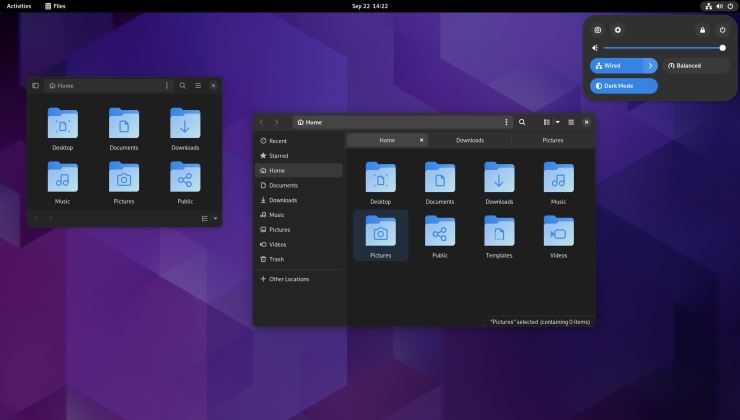
I dislike Gnome on a pure desktop or non-touch laptop, in part because of UI decisions I think are meant to work better on a touchscreen. It's really good on a touchscreen though aside from the horrid onscreen keyboard.
> I really think GNOME is good at making an interface that works well on both,
I agree with the comment from @zak on this.
I have to disagree.
I have used GNOME (both GNOME Mobile and Phosh) on phones, and it makes more sense there, but it's still a bit clunky and fiddly.
Example: you only get half the tiny screen for your app launcher. So it fills up fast. So, you put apps in groups. BUT you can't pin groups to the fast-launch bar thing.
On the desktop, IMHO it does not work well. It works minimally, in a way that's only acceptable if you don't know your way around a more full-featured desktop. It feels like trying to use a computer with one hand tied behind my back. Yes, it's there, it's usable, but it breaks lots of assumptions and is missing commonplace core features.
Simple features: desktop icons are handy.
GNOME: ew, how ugly and untidy! We're taking them off you.
Obvious but complex features: menu bars go back to the 1970s and by the mid-1980s were standardised, with standard shortcut keys, with standardised entries in standardised places. They work well with a mouse, they work well with a keyboard, they work well with screenreaders for people with vision disabilities.
GNOME: Yeah, screw all those guys. Rips them out.
Non-obvious but core features: for over 30 years in Linux GUIs, you could middle-click on a title bar to send it to the back of the window stack.
GNOME: screw those guys. Eliminates title bars.
No, GNOME does not work _well_ on both. It is sort of minimally usable.
On both, it's minimally functional if you are not fussy, don't want to customise, don't have ingrained habits, and don't use keyboards and keyboard shortcuts much.
I actually think GNOME works best with the keyboard, they put a lot of effort into ensuring you can do everything without a mouse do to accessibility reasons. Even with a mouse, I don't hate the larger buttons. It means I don't have to be as precise with my mouse clicks.
I also think it breaking traditions is a good thing. It feels weird at first but without someone trying something new we won't see any progress. I do think they're a bit fast to do away with things they see as outdated but GNOME has a very particular design anyway that lets you get shit done when you learn it
It worked in Windows 2 and 3 and everything since. It worked in DOS since about 1990. It worked in OS/2. It works in Xfce, and up to a point in LXDE, LXQt, GNOME 1/2, MATE, Cinnamon, EDE, XPde, and lots of other Linux and xBSD GUIs. A form of it works on MacOS.
But GNOME ripped the whole UI out and has re-invented a worse version of its own. (KDE has partially kept something like it but changed half the keystrokes, which is almost worse.)
If you're blind or have some disability that stops you using a mouse, say, this makes it a TONNE more work.
Yeah. I'm actually planning on making a qwidgets based CUA desktop for BSD (and /Linux too I suppose). Despite not hating GNOME and being able to defend it we need a good unixy (IE, do one thing and do it well) desktop that doesn't try to do everything or pull in that many dependencies (it won't be based on KDEs libraries for example)
I think it's called "quick settings" (top right on https://www.gamingonlinux.com/uploads/articles/tagline_image... ) where the power, internet, etc menus are. I think that's mostly just the thing that I remembered most aside from the shortcuts menu changes, but it was mainly the fact that I couldn't patch in my need for customization with extensions well enough anymore that made me realize GNOME wasn't my thing. It was just what was there when I started and I worked around it.
I had an Android phone and my friend had a Windows Phone. I wanted to get a Windows phone but by the time I came around to needing a new device it was already killed off. Too bad.
I've got the Dell version of the DGX Spark as well, and was very impressed with the build quality overall. Like Jeff Geerling noted, the fans are super quiet. And since I don't keep it powered on continuously and mainly connect to it remotely, the LED is a nice quick check for power.
I've been an Asahi user since the early stages of the project when it used Arch. Today, I run Fedora Asahi Remix on a Mac Studio M1 Ultra with the Sway desktop, and it truly has been the perfect Linux workstation in every way.
hey have you ever tried compiling the linux kernel on it? It's often difficult in my experience to find compile benchmarks for Apple Silicon that aren't Xcode




reply